


Seeing two of everything is unsettling. It can make reading, pouring a cup of tea, walking down stairs or driving suddenly feel unsafe. The medical term for this is diplopia, and it is one of the more common reasons people visit an eye doctor urgently.
Double vision is a symptom, not a disease. It is the eye’s way of signalling that something has changed sometimes something as simple as a dry, uneven tear film, and sometimes something that needs same-day medical attention. This guide explains what diplopia means, how to work out which type you have, what causes it, and how it is treated.
Key Takeaway: What Is Diplopia?
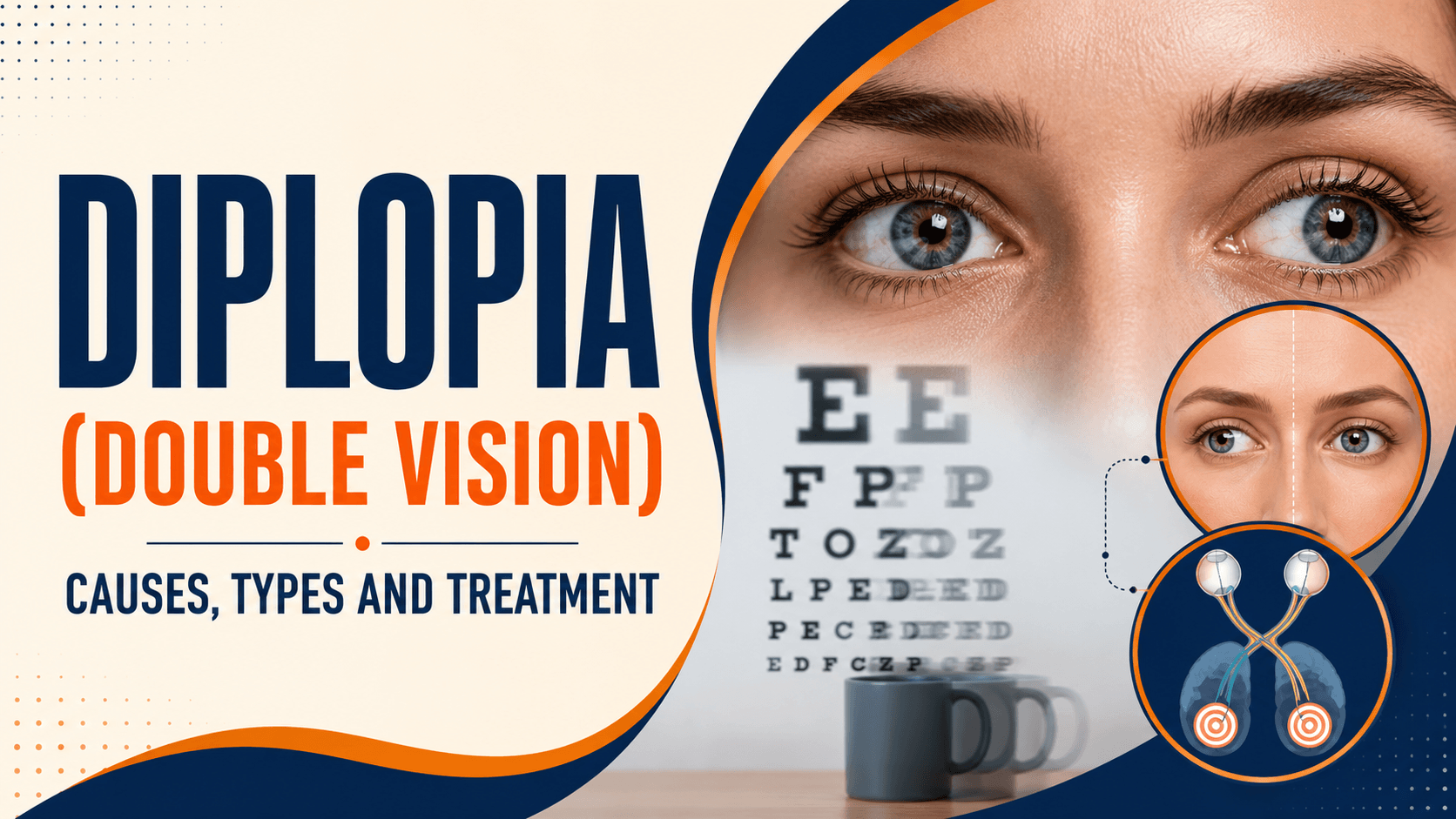
Diplopia is the medical term for double vision: seeing two images of a single object. It happens either because of an optical problem inside one eye, or because the two eyes are no longer pointing at exactly the same spot. Double vision that involves only one eye is usually less serious. Double vision that appears only when both eyes are open, especially if it starts suddenly, needs prompt medical assessment.
What Is Diplopia? A Simple Explanation
Normally, your two eyes look at the same object from slightly different angles. Your brain receives both images and fuses them into one clear, three-dimensional picture.
Diplopia occurs when this system breaks down. Either one eye sends a distorted, doubled image because light is not being focused cleanly, or the two eyes point in slightly different directions so the brain receives two images it cannot merge.
The second image may appear side by side (horizontal diplopia), above or below (vertical diplopia), or tilted (oblique diplopia). Some people describe it not as two separate images but as a faint shadow, smear or “ghosting” around letters and lights.
The 10-Second Self-Check: Is Your Double Vision Monocular or Binocular?
This single check tells you and your doctor more than almost anything else. Do it while you are actually seeing double.
- Cover your right eye. Note whether the doubling is still there.
- Uncover, then cover your left eye. Note again.
- Compare what happened.
If the double vision disappears whenever either eye is covered, it is binocular diplopia. Both eyes are needed to produce the doubling, which points to an alignment problem between the eyes.
If the double vision is still there with one eye covered, it is monocular diplopia. The doubling comes from that one eye alone, and the cause is usually optical.
A note on wording: the American Academy of Ophthalmology advises asking whether the doubling resolves on closing either eye, rather than the vaguer “does it go away when you cover one eye.” The distinction matters, because in monocular diplopia the doubling does vanish when the affected eye is covered, which can easily be mistaken for the binocular pattern.
Monocular vs Binocular Diplopia: Key Differences
|
Feature |
Monocular diplopia |
Binocular diplopia |
|
When you see double |
With one eye open, and it continues when the other eye is covered |
Only when both eyes are open |
|
What happens on covering either eye |
Doubling persists when the unaffected eye is covered |
Doubling disappears |
|
Where the problem lies |
Inside the affected eye (cornea, lens, tear film) |
Eye alignment: muscles, nerves or brain |
|
Common causes |
Astigmatism, dry eye, cataract, keratoconus |
Squint, nerve palsy, thyroid eye disease, myasthenia gravis |
|
Usual urgency |
Less urgent, but still needs assessment |
More urgent, especially if sudden |
|
Typical second image |
Faint, shadowy, “ghost” image |
Two distinct, separate images |
What Causes Diplopia?
Because the two types have almost entirely different causes, it helps to look at them separately.
Causes of monocular diplopia (one eye)
Here, light is not being focused cleanly by the front of the eye. Common causes include:
- Uncorrected refractive error, especially astigmatism – an unevenly curved cornea splits light into overlapping images.
- Dry eye – an unstable tear film makes the corneal surface irregular, so vision smears or ghosts and often fluctuates with blinking.
- Cataract – a clouding lens scatters light and is a very common cause of ghosting or doubling in one eye in older adults.
- Keratoconus – progressive thinning and cone-shaped bulging of the cornea distorts the image.
- Corneal scarring or irregularity following injury, infection or previous surgery.
- A displaced or dislocated lens, sometimes after trauma.
Causes of binocular diplopia (both eyes)
Here the eyes are misaligned. The causes range from long-standing and stable to genuinely urgent:
- Squint (strabismus) – a childhood squint that the brain once suppressed can “decompensate” in adulthood and start causing double vision.
- Cranial nerve palsies – the third, fourth and sixth cranial nerves control the eye muscles. If one is affected, the eye cannot move fully in one direction. This is described as a paralytic squint.
- Thyroid eye disease – swelling and stiffening of the eye muscles restricts movement.
- Myasthenia gravis – a neuromuscular condition that causes fluctuating weakness. The double vision is often worse at the end of the day or when tired, and may come with a drooping eyelid.
- Orbital trauma – a fracture of the eye socket can trap or tether an eye muscle.
- Stroke, aneurysm, brain tumour or multiple sclerosis – less common, but important reasons why new binocular diplopia is taken seriously.
Causes especially relevant in India
Diabetes and high blood pressure are widespread in India, and both are well-recognised causes of the small-vessel (microvascular) nerve palsies that produce sudden binocular double vision in adults. In these cases the double vision often appears abruptly, usually without severe pain, and frequently improves over weeks to a few months as the nerve recovers.
If you have diabetes, double vision is a reason to have your eyes and blood sugar reviewed – and a reminder to keep up with screening for diabetic retinopathy, which is a separate but equally important diabetes-related eye problem.
Road traffic and workplace injuries are another significant cause of orbital trauma leading to diplopia.
Warning Signs: When Double Vision Is a Medical Emergency
Seek emergency medical care immediately if double vision appears suddenly, or comes with any of the following:
- Severe or unusual headache
- A drooping eyelid (ptosis), particularly with a pupil that looks larger than the other
- Weakness or numbness in the face, arm or leg
- Slurred speech, confusion or difficulty swallowing
- Loss of balance, dizziness or difficulty walking
- Eye pain, especially on eye movement, or a bulging eye
- Recent head or eye injury
In adults over 60, double vision together with scalp tenderness, jaw ache while chewing, or new persistent headache also needs urgent same-day assessment.
These features can indicate a problem affecting the nerves or blood supply rather than the eye itself. Do not wait to see whether it settles on its own.
Other Symptoms That May Occur With Diplopia
Double vision rarely arrives alone. Depending on the cause, you may also notice:
- Eye strain, headache or a pulling sensation around the eyes
- Tilting or turning your head to one side to make the doubling go away
- Closing or covering one eye to see clearly
- Nausea or unsteadiness, particularly on stairs or uneven ground
- A visibly misaligned eye
- Difficulty judging distance while pouring, reaching or driving
How Is Diplopia Diagnosed?
Diagnosis is painless and focuses on two questions: which type of diplopia is it, and what is causing it.
- History. When it started, whether it came on suddenly, whether it is constant or intermittent, whether it changes with direction of gaze or time of day, and your general health.
- Vision and refraction testing. Measuring sight in each eye and checking for uncorrected refractive error or astigmatism.
- The monocular/binocular check. Repeating the cover-one-eye test formally.
- Cover test and ocular motility testing. Watching how each eye moves in all directions of gaze to identify which muscle or nerve is underperforming. You can read more about the squint test used to assess alignment.
- Prism measurement and diplopia charting. Prisms quantify the degree of misalignment, and a diplopia chart maps where in your field of view the doubling is worst. This helps pinpoint the affected muscle and track change over time.
- Slit-lamp and dilated examination. Assessing the cornea, tear film, lens and retina – essential for monocular causes.
- Further investigations where indicated. For binocular diplopia this may include MRI or CT imaging, and blood tests for thyroid function, myasthenia gravis, blood sugar or inflammation.
Monocular diplopia usually needs no scans. Binocular diplopia often does, because the cause may lie outside the eye.
Diplopia Treatment Options
There is no single treatment for diplopia. Because it is a symptom, treatment is directed at the underlying cause – which is exactly why an accurate diagnosis matters so much.
Treating monocular diplopia
- Updated glasses or contact lenses for uncorrected refractive error and astigmatism.
- Dry eye treatment, including lubricating drops and management of the underlying eyelid or tear film problem.
- Cataract surgery, where a cataract is the cause. Replacing the clouded lens usually resolves the doubling from that eye.
- Specialised contact lenses or corneal treatment for keratoconus and irregular corneas.
Treating binocular diplopia
- Treating the underlying medical condition – for example stabilising blood sugar, managing thyroid eye disease, or treating myasthenia gravis with the relevant specialist.
- Prisms ground into or stuck onto glasses, which shift the image so the two views line up again. Prisms suit small, stable misalignments.
- Temporary patching or occlusion of one eye to relieve disabling double vision while the cause is investigated or while a nerve palsy recovers.
- Botulinum toxin injection into a specific eye muscle in selected cases, often as a temporary measure.
- Squint (strabismus) surgery to reposition the eye muscles and restore alignment. This is generally considered once the misalignment has been stable for several months, or where recovery is not expected.
When surgery is considered
Surgery is not the first step. It is usually considered when the double vision is persistent and disabling, the underlying cause has been treated or has stabilised, and glasses or prisms are not enough. Because eye muscle surgery is planned around precise measurements, your surgeon will want stable readings over repeated visits before operating. As with any procedure, results vary between patients, and some people need more than one procedure or continue to use prisms afterwards.
Can Diplopia Be Cured? What Recovery Realistically Looks Like
In many cases, yes but “cure” depends entirely on the cause.
- Double vision from an uncorrected prescription, dry eye or cataract usually resolves fully once that problem is treated.
- Double vision from a microvascular nerve palsy related to diabetes or blood pressure often improves on its own over weeks to a few months, with prisms or temporary patching used for comfort meanwhile.
- Double vision from thyroid eye disease or myasthenia gravis usually improves when the underlying condition is controlled, though it can fluctuate.
- Double vision from a long-standing squint, significant trauma or a permanent nerve injury may need prisms or surgery, and the goal may be comfortable single vision in the positions you use most, rather than perfect alignment in every direction of gaze.
No eye doctor can promise a specific outcome before establishing the cause. What is reliably true is that most people with diplopia can be significantly helped, and that delay rarely improves the situation.
Living With Double Vision: Practical Tips
While your diplopia is being investigated or is recovering, these measures help you stay safe and comfortable:
- Do not drive while you are seeing double. Ask your doctor when it is safe to resume.
- Take extra care on stairs and kerbs, where depth perception matters most.
- Use temporary occlusion if advised covering one eye with a patch, or frosted tape on one spectacle lens, immediately removes the second image.
- Alternate which eye you cover if you are patching for long periods, and follow your doctor’s advice, particularly for children.
- Improve lighting and increase text size on screens and while reading.
- Note the pattern. Record when the doubling is worst, in which direction of gaze, and whether it varies through the day. This information genuinely helps your doctor.
Which Doctor Should You See for Double Vision?
Start with an ophthalmologist (eye specialist). They can determine whether the cause is optical or an alignment problem, and treat most causes directly.
If the assessment points to a nerve, muscle or brain-related cause, you may be referred within eye care to a specialist in neuro-ophthalmology, which deals with the connection between the eyes and the nervous system, or to a squint specialist for alignment surgery. Some patients are also seen jointly with a neurologist, endocrinologist or physician, depending on the underlying condition.
If your double vision came on suddenly or is accompanied by any of the red-flag symptoms listed earlier, go to an emergency department rather than waiting for an outpatient appointment. Otherwise, book an appointment with an eye specialist promptly.
Conclusion
Diplopia is a symptom worth respecting. Establishing whether your double vision is monocular or binocular is the single most useful first step, because the two point to very different causes and very different levels of urgency. Monocular double vision usually reflects a correctable optical problem in one eye. Binocular double vision reflects an alignment problem and, particularly when sudden, may signal a condition needing immediate care.
Most causes of double vision can be treated or significantly improved, from new glasses and dry eye management to prisms, cataract surgery and squint surgery. The variable that matters most is time. If you are seeing double, arrange an eye examination promptly, and if it began suddenly or came with headache, drooping eyelid or weakness, treat it as an emergency.