



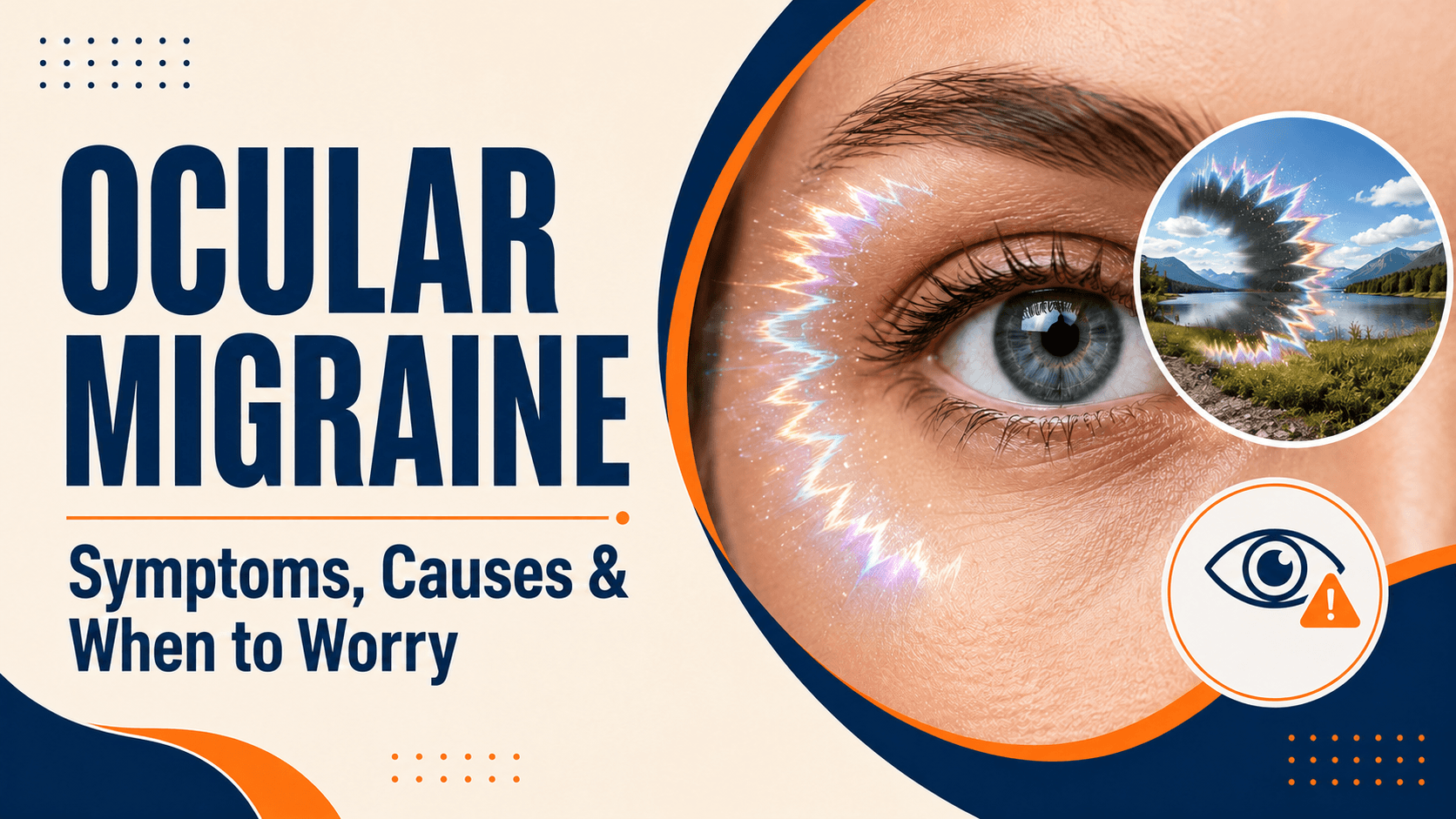
It usually starts as a small shimmering spot near the centre of your vision. Over a few minutes, it grows, often into a jagged, flickering arc of zigzag lines that drifts across your sight. Then, twenty or thirty minutes later, it fades and everything is normal again.
If this has happened to you, it was frightening and quite possibly you were told it was an “ocular migraine”. That answer is usually correct and usually reassuring. But the term is used loosely for two different conditions, only one of which needs careful investigation. This guide explains the difference and the warning signs that genuinely matter.
Key Takeaway: What Is an Ocular Migraine?
“Ocular migraine” is a loose term for migraine that causes visual symptoms such as flashing lights, zigzag lines or a temporary blind spot. Most cases are migraine with visual aura, which affects the vision in both eyes, comes from the brain rather than the eye, and is harmless. A rarer form, retinal migraine, affects vision in one eye only. Because one-eye vision loss can also be caused by problems with blood supply, it always needs medical assessment rather than self-diagnosis.
What Is an Ocular Migraine?
A migraine is a neurological condition, not simply a bad headache. It can produce a wide range of symptoms, and in some people it produces visual ones.
The confusing part is the label. “Ocular migraine” was historically used for any migraine with visual symptoms. Doctors now prefer two more precise terms: migraine with aura and retinal migraine because they describe different things happening in different places. Some sources still use “ocular migraine” to mean one, some the other. If two websites appear to contradict each other on this, that is why.
Two other terms you may encounter mean much the same as migraine with aura: ophthalmic migraine and eye migraine. Neither is a formal diagnosis.
The Two Conditions People Call “Ocular Migraine”
Migraine with visual aura
This is by far the more common of the two. The disturbance begins in the visual part of the brain, not in the eye. Because both eyes send information to that same area, the symptom appears in the same part of the visual field of both eyes even though most people are convinced it is coming from one eye.
Typical features are “positive” ones, meaning you see something that is not there: shimmering spots, flickering zigzag or castle-wall shapes, or a bright expanding arc. There may also be a blind spot within it, known as a scintillating scotoma. It usually builds gradually over about five minutes and settles within an hour.
Retinal migraine
This is genuinely rare. Here the disturbance involves the eye itself, so it affects one eye only. Symptoms tend to be “negative”: a loss of vision, dimming, or a blind area in that eye, sometimes with flickering, and typically lasting under an hour before vision returns fully.
Retinal migraine is what doctors call a diagnosis of exclusion. Reduced blood supply to the eye can produce very similar symptoms, so other causes must be ruled out before migraine is accepted as the explanation. It is most often described in younger adults who already have a history of migraine with aura.
|
Feature |
Migraine with visual aura |
Retinal migraine |
|
Where it starts |
The brain’s visual cortex |
The eye itself |
|
Eyes affected |
Both eyes, same part of the visual field |
One eye only |
|
Typical symptoms |
Zigzag lines, shimmering, flickering arcs |
Vision dimming, blind area, or loss |
|
How common |
Common |
Rare |
|
Duration |
Usually 20–60 minutes |
Usually under an hour |
|
Headache |
Often follows, but not always |
May follow, or may be absent |
|
Assessment needed |
Confirm diagnosis; urgent only if features are atypical |
Always assessed to exclude blood-supply causes |
One Eye or Both? The Check That Changes Everything
This single observation is the most useful thing you can bring to your appointment, because it points your doctor in completely different directions.
If it is safe to do so during an episode, cover one eye, then the other, and note what happens:
- If the disturbance is still there with either eye covered, it is affecting both eyes. That points towards migraine with aura.
- If it disappears when you cover one particular eye, and is present only when that eye is open, it is genuinely one-eyed. That needs proper assessment.
Two honest caveats. First, this is difficult to do reliably in the moment, and almost impossible to reconstruct afterwards, so if you are not sure, say you are not sure rather than guessing. Second, this is a way of describing your symptoms accurately, not a way of diagnosing yourself. Do not use it to talk yourself out of seeking help if something feels wrong.
If you have any of the warning signs listed further down, seek care immediately rather than pausing to test yourself.
What Ocular Migraine Symptoms Look Like
Visual aura tends to follow a recognisable pattern:
- A small blind or shimmering spot appears, often near the centre of vision
- It expands gradually over roughly five minutes
- It often takes the form of a jagged, flickering, zigzag arc, sometimes with bright or coloured edges
- It drifts outward across the visual field
- It resolves within about an hour, leaving vision completely normal
Some people also experience tingling in the hand or face, difficulty finding words, or unusual sensitivity to light and sound. A headache may follow, and many people feel drained for a day afterwards.
Retinal migraine feels different. Rather than bright shapes, people describe part or all of the vision in one eye dimming, greying out or going blank, before returning.
Can You Have an Ocular Migraine Without a Headache?
Yes, and it is more common than most people realise. Visual aura can occur with no headache at all, sometimes called silent migraine or acephalgic migraine.
This causes considerable alarm, particularly in people over 50 who have never had migraines before, because a sudden visual disturbance without pain feels like it must be a stroke. That instinct is reasonable. A first episode, or a new pattern of episodes in later life, should be medically assessed rather than assumed to be migraine even if it resolves completely.
Once the diagnosis is established and the pattern is familiar, aura without headache is generally not dangerous.
What Triggers an Ocular Migraine?
Triggers vary enormously between individuals, and many episodes have no identifiable trigger at all. Commonly reported ones include:
- Skipped meals, dehydration, or too much or too little caffeine
- Poor or irregular sleep
- Stress, or the period of relaxation immediately after stress
- Bright, flickering or glaring light
- Prolonged screen use without breaks, which also contributes to digital eye strain
- Hormonal changes, including around menstruation
- Certain foods, alcohol, and strong smells
- Weather and pressure changes
Keeping a simple diary of what preceded each episode is more useful than eliminating foods speculatively. Patterns often emerge within a few months.
When to Worry: Warning Signs That Need Urgent Care
Most visual aura is harmless. Seek emergency medical care if any of the following apply:
- Your first ever episode of visual disturbance, particularly if you are over 50 or have no migraine history
- Vision loss in one eye, especially if described as a curtain or shade coming down
- Symptoms lasting longer than an hour, or vision that does not return fully to normal
- Weakness, numbness, facial droop, slurred speech or confusion
- A sudden severe headache unlike any you have had before
- Visual symptoms with eye pain, redness, or seeing halos around lights
- New flashes of light with a shower of floaters, or a dark shadow spreading across your vision
- Scalp tenderness, jaw ache while chewing, or new persistent headache in anyone over 50
Two further situations worth a non-urgent medical discussion: aura that always appears on the same side every single time, and any change in your usual pattern.
Conditions That Can Mimic an Ocular Migraine
Several conditions produce similar visual symptoms, and distinguishing them is precisely why assessment matters.
|
Condition |
How it typically differs |
Urgency |
|
Amaurosis fugax |
Painless loss of vision in one eye, often like a curtain descending, usually seconds to minutes; linked to blood supply and can precede a stroke |
Emergency |
|
Retinal artery occlusion |
Sudden, painless, severe loss of vision in one eye that does not recover |
Emergency |
|
Flashes with many new floaters, and a shadow or curtain in the peripheral vision that persists |
Emergency |
|
|
Giant cell arteritis |
Transient or lasting vision loss in over-50s, with scalp tenderness, jaw pain or fatigue |
Emergency |
|
Transient ischaemic attack |
Visual disturbance with weakness, numbness or speech difficulty |
Emergency |
|
Acute angle-closure glaucoma |
Eye pain, redness, halos around lights, headache and nausea |
Emergency |
|
Posterior vitreous detachment |
Occasional flashes and floaters, usually in older adults, without zigzag patterns |
Prompt assessment |
The pattern that most reliably suggests ordinary migraine aura is a positive visual phenomenon: bright, moving, zigzag shapes that build over minutes and then fade rather than a simple loss of vision.
How Ocular Migraine Is Diagnosed
There is no single test that confirms migraine. Diagnosis rests on the history and on excluding other causes.
- Detailed history. What you saw, in which eye or field, how it began, how long it lasted, and what came before and after.
- Vision and eye examination. Checking visual acuity, pupils, eye movements and the front of the eye.
- Dilated retinal examination. Inspecting the retina and its blood vessels, which is essential if symptoms involved one eye.
- Visual field testing, where a persistent field defect is suspected.
- Blood pressure and general assessment, and blood tests where inflammation or a vascular cause is being considered.
- Imaging or vascular studies when the picture is atypical, symptoms are one-eyed, or a neurological cause is suspected.
Because the eye, the brain and the blood vessels supplying both may be involved, assessment sometimes includes a neuro-ophthalmology opinion or joint care with a neurologist or physician.
Treatment and Prevention
Treatment depends on how often episodes occur and how disruptive they are. Visual aura itself often needs no treatment, since it resolves on its own.
During an episode, most people find it helps to stop what they are doing, sit or lie down somewhere quiet and dimly lit, and wait for the disturbance to pass. Simple pain relief may help any headache that follows.
Preventive approaches begin with identifying and managing triggers, regular sleep, adequate hydration, regular meals and stress management. Where episodes are frequent or disabling, doctors may consider preventive medication. Several classes of prescription medicine are used, and the choice depends on your medical history, other conditions and how you respond, so this must be individualised by a doctor rather than self-selected. No single treatment suits everyone, and results vary.
One point specific to retinal migraine: because reduced blood supply may be involved, management usually includes attention to cardiovascular risk factors such as blood pressure, smoking and cholesterol, alongside migraine care.
If you have migraine with aura, mention it to your doctor when discussing hormonal contraception or cardiovascular risk, as this can influence their advice.
What to Do During an Episode
- Stop driving or operating machinery immediately and pull over somewhere safe. Aura significantly affects vision and reaction time, and this is the single most important practical precaution.
- Move somewhere calm and dim and rest your eyes.
- Note the time the symptoms started. Duration genuinely helps your doctor.
- If you can, and if it feels safe, check one eye at a time and remember what you observed.
- Do not drive again until vision is fully normal and you feel steady.
- Seek emergency care if any warning sign above is present, particularly weakness, speech difficulty, or vision that does not return.
Conclusion
For most people, an ocular migraine is a dramatic but harmless event: a shimmering zigzag pattern that builds, drifts and fades, leaving vision entirely normal. Understanding that it usually begins in the brain rather than the eye, and affects both eyes rather than one, takes much of the fear out of it.
What deserves attention is anything that breaks that pattern: a first episode, vision loss in one eye, symptoms lasting beyond an hour, vision that does not fully return, or any weakness, speech difficulty or severe headache. Those features are not migraine until a doctor has said so.
If you have experienced visual disturbance and have not had it assessed, book an eye examination rather than waiting to see whether it happens again. Bringing a clear description of what you saw, in which eye, and how long it lasted will make that appointment considerably more useful.