


If you are preparing for cataract surgery and have been told you also have astigmatism, you have probably been offered a toric lens, usually at additional cost. It is one of the more consequential choices in the whole process, and one of the least well explained.
This guide covers what a toric lens actually does, who benefits, what results are realistic, and the questions worth asking before you decide.
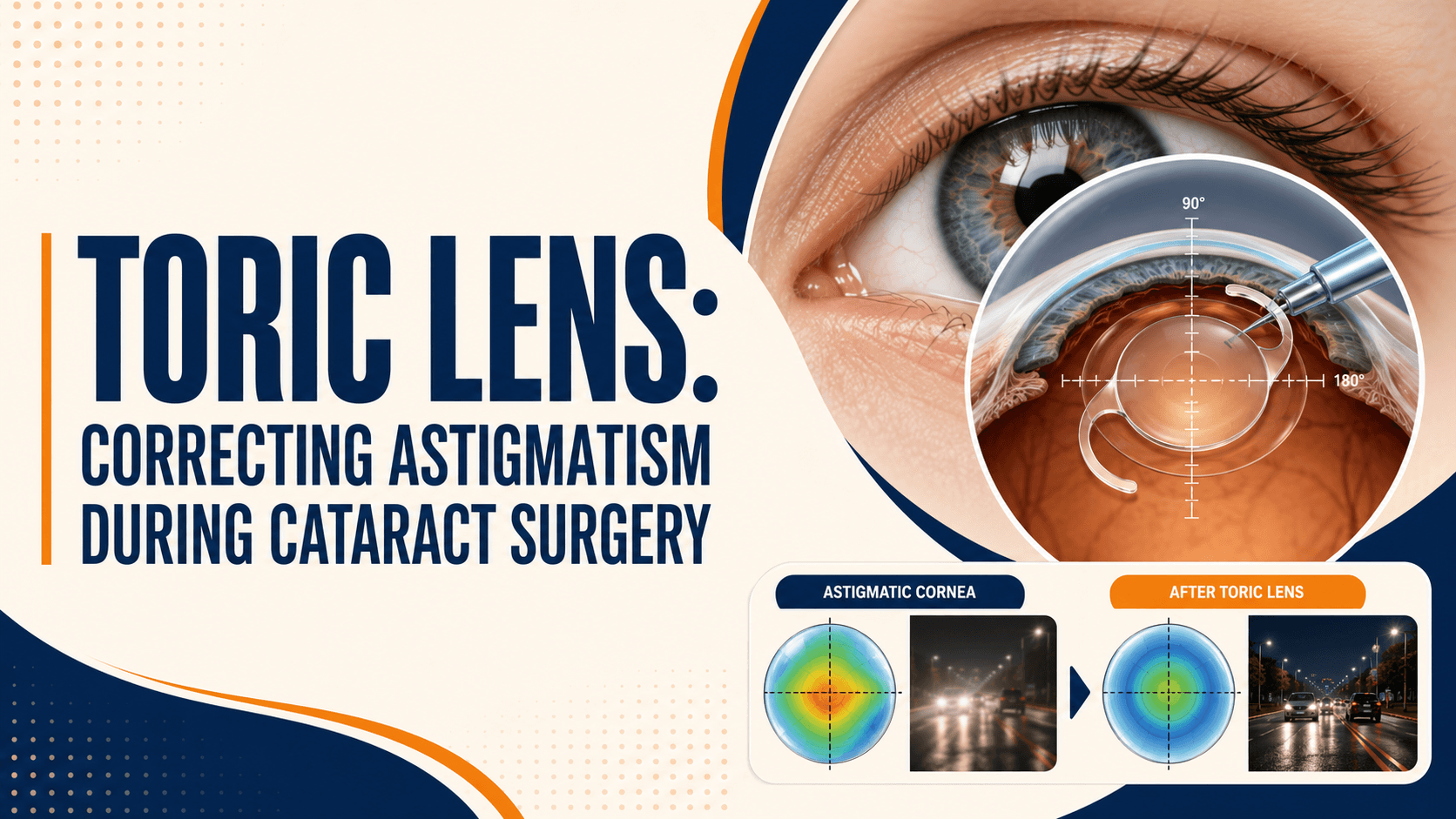
Key Takeaway: What Is a Toric Lens?
A toric lens is a lens with different focusing powers in different directions, designed to correct astigmatism. In cataract surgery, a toric intraocular lens (toric IOL) replaces the eye’s clouded natural lens and corrects pre-existing corneal astigmatism at the same time. A standard monofocal lens corrects the cataract but leaves astigmatism uncorrected, so glasses are usually still needed for clear distance vision. A toric IOL must be aligned precisely along a specific axis, and its accuracy depends on that alignment being maintained.
What Is a Toric Lens?
The word “toric” describes the shape. A normal lens curves equally in all directions, like the surface of a ball. A toric surface curves more in one direction than another, more like the side of a rugby ball. That uneven curvature is what allows it to counteract astigmatism.
One point of confusion is worth clearing up immediately. “Toric lens” is used for three different things:
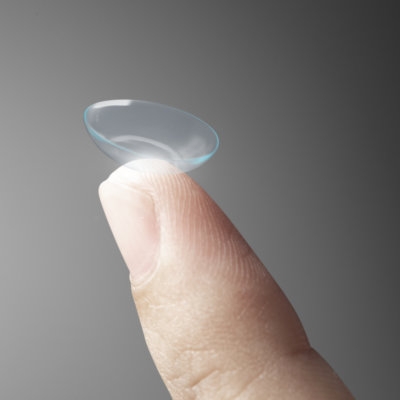
- Toric contact lenses – soft or rigid lenses worn on the eye’s surface to correct astigmatism
- Toric spectacle lenses – the cylindrical correction in your glasses prescription
- Toric intraocular lenses (toric IOLs) – implanted permanently inside the eye during cataract surgery
This article is about the third. If you have arrived here looking for contact lenses for astigmatism, that is a different product entirely.
Why Astigmatism Needs Separate Attention in Cataract Surgery
A cataract is a clouding of the eye’s natural lens, and cataract surgery removes it and replaces it with a clear artificial lens.
Astigmatism is a different problem. It usually comes from the cornea, the clear front window of the eye, being shaped unevenly. Because the cornea is not removed during cataract surgery, its astigmatism remains afterwards unless something is done about it specifically.
This matters more than many patients expect. Astigmatism of around 0.75 dioptres or more commonly blurs distance vision noticeably, and a substantial proportion of cataract patients have at least this much corneal astigmatism. Without correction, someone can have a technically successful cataract operation and still need glasses to see clearly in the distance.
There are broadly three ways to handle it: implant a toric IOL, make small corneal incisions to reduce the astigmatism, or implant a standard lens and correct the remaining astigmatism with glasses afterwards. None is automatically right for everyone.
How a Toric IOL Corrects Astigmatism
A toric IOL has cylindrical power built into it, oriented along a specific meridian. During surgery, the lens is rotated so that its correcting axis lines up with the axis of the cornea’s astigmatism. When they align, the lens counteracts the corneal irregularity and light focuses more evenly on the retina.
Toric IOLs carry small alignment markings for this purpose, and the target axis is calculated before surgery from detailed measurements of your cornea.
The whole benefit depends on that alignment. Get it right, and vision is sharper; drift away from it and the correction diminishes measurably, which is why the sections below on measurement and rotation matter as much as the lens itself.
Who Is Suitable for a Toric Lens?
A toric IOL is generally considered when:
- You have regular corneal astigmatism, typically around 0.75 to 1.00 dioptres or more
- You are having cataract surgery or a refractive lens exchange
- Your cornea is otherwise healthy and its measurements are stable and reproducible
- Your eye has adequate capsular and zonular support to hold the lens steadily in position
- You want to reduce your dependence on distance glasses and accept the additional cost
It may be less suitable, or need careful discussion, if you have irregular astigmatism such as in keratoconus, significant corneal scarring, an unstable tear film, or weak zonules that make lens position less predictable. In eyes with inadequate capsular support, a different approach such as a glued IOL may be needed, and that changes the options available.
Only a full pre-operative assessment can establish suitability.
Toric Lens vs Standard Monofocal Lens
|
Feature |
Standard monofocal IOL |
Toric IOL |
|
Corrects the cataract |
Yes |
Yes |
|
Corrects corneal astigmatism |
No |
Yes |
|
Distance vision without glasses |
Often blurred if astigmatism present |
Usually clearer |
|
Reading glasses still needed |
Yes |
Yes, unless a multifocal toric is chosen |
|
Depends on precise axis alignment |
No |
Yes |
|
Risk of rotation affecting result |
Not applicable |
Yes, though uncommon |
|
Cost |
Standard |
Higher |
The honest summary: a toric lens is not a better lens in general. It is the appropriate lens if you have meaningful corneal astigmatism. In an eye with little or no astigmatism, it offers no advantage.
Types of Toric IOL Available
Toric correction can be combined with different focusing designs:
- Monofocal toric – corrects astigmatism and gives clear vision at one distance, usually far. Reading glasses are still needed.
- Extended depth of focus (EDOF) toric – corrects astigmatism and provides a continuous range from distance to intermediate, with glasses often still used for fine near work.
- Multifocal or trifocal toric – corrects astigmatism and provides near, intermediate and distance vision, aiming to minimise glasses use.
Premium multifocal designs can be associated with more glare and halos, particularly at night, and they are not suitable for every eye. Your surgeon should discuss these trade-offs rather than presenting the most expensive lens as automatically the best.
The Measurements That Decide the Outcome
This is the part patients almost never hear about, and it directly affects your result.
Before a toric IOL is selected, the surgeon needs precise measurements of the magnitude and axis of your corneal astigmatism. These typically come from:
- Biometry – measuring the eye’s length and curvature to calculate lens power
- Keratometry – measuring corneal curvature
- Corneal topography or tomography – mapping the cornea’s full surface, including its back surface, and confirming the astigmatism is regular
- Repeat measurements – because agreement between different devices confirms reliability
An unstable tear film can distort these readings. If you have dry eye, treating it before your measurements are taken can meaningfully improve the accuracy of toric lens planning. If you have worn rigid contact lenses, you will usually be asked to stop for a period beforehand, as they temporarily reshape the cornea.
If your surgeon asks you to return for repeat measurements, that is a sign of careful practice, not indecision.
What Happens During and After Surgery
The operation itself is the same routine cataract procedure, with one addition: the lens must be rotated to its target axis and left there.
Surgeons use various methods to mark and confirm the axis, from manual reference marks to digital image-guided systems that overlay the target axis during surgery. Laser-assisted cataract surgery can also be used to assist certain steps.
Afterwards, recovery follows the usual cataract pathway. Vision typically improves over the first days to weeks. Your surgeon will check the lens position at follow-up, since alignment can be assessed at the slit lamp with the pupil dilated.
Follow your post-operative drop schedule and avoid rubbing the eye. Most rotation, when it happens, occurs in the early period after surgery.
What Results Can You Realistically Expect?
Most patients with a well-planned, well-aligned toric IOL see a clear improvement in unaided distance vision compared with what a standard lens would have given them.
Some honest limits are worth stating:
- A toric IOL reduces astigmatism; it does not always eliminate it. Residual astigmatism of up to around 0.75 dioptres is common and is generally considered an acceptable result.
- You will still need reading glasses with a monofocal toric lens, because it corrects astigmatism, not presbyopia.
- Some patients still need a light distance prescription, particularly for night driving.
- Outcomes vary between individuals, and no surgeon can guarantee a spectacle-free result.
The realistic goal is substantially better unaided distance vision and reduced dependence on glasses, not certainty of never needing them.
Limitations and Possible Complications
Toric IOLs carry the same risks as any cataract surgery, including infection, inflammation, swelling and, rarely, retinal problems. A few issues are specific to toric lenses.
Rotation of the lens
This is the main toric-specific concern. Because the correction depends on axis alignment, rotation reduces the benefit in a measurable way: roughly 3.3% of the astigmatic correction is lost for every degree of misalignment. By around 10 degrees, approximately a third of the correction is gone, and at around 30 degrees the astigmatic benefit is essentially lost.
The reassuring part is that significant rotation is uncommon with modern lenses. Industry standards require most lenses to stay within 5 degrees, and contemporary single-piece platforms generally meet or exceed that in the large majority of eyes.
Residual astigmatism
Even with perfect alignment, some astigmatism can remain. Contributing factors include variability between measurement devices, the contribution of the cornea’s back surface, and astigmatism induced by the surgical incision itself. Where residual astigmatism is troublesome, options include glasses, a laser refractive procedure, or repositioning the lens.
When a toric lens is not the right choice
A toric IOL may be inappropriate where astigmatism is irregular rather than regular, where corneal disease makes measurements unreliable, where capsular or zonular support is inadequate, or where the amount of astigmatism is too small to justify the additional cost.
What Toric Lenses Cost in India
A toric IOL is classified as a premium lens and costs more than a standard monofocal lens. The total you pay depends on several factors:
- The type of toric lens chosen: monofocal toric is less expensive than EDOF or trifocal toric
- The lens manufacturer and model
- The hospital and city
- Whether laser assistance or digital axis-guidance systems are used
- Pre-operative investigations and follow-up visits
Insurance is an important practical point. Health insurance in India commonly covers cataract surgery up to a defined limit, but premium lens upgrades are often treated as an elective enhancement and may not be fully covered. Ask the hospital’s insurance desk for a written breakdown of what is included before deciding, as policies vary considerably.
Prices change over time and between centres, so ask for a current, itemised quotation rather than relying on figures published online.
Questions Worth Asking Your Surgeon
Take these to your consultation:
- How much corneal astigmatism do I actually have, and is it regular?
- Would a standard lens leave me needing glasses for distance?
- Which type of toric lens are you recommending, and why that one for my eye?
- How will you determine and mark the alignment axis?
- What residual astigmatism should I realistically expect afterwards?
- What happens, and what would it cost, if the lens rotates and needs repositioning?
- Will I still need glasses for reading, night driving, or both?
- What exactly does the quoted price include, and what will insurance cover?
Conclusion
A toric lens solves a specific problem: astigmatism that cataract surgery alone would leave behind. For someone with meaningful corneal astigmatism, it can be the difference between needing glasses for everyday distance vision and not.
What determines the result is less the lens itself than the care around it: accurate corneal measurements, a healthy tear film at the time those measurements are taken, precise alignment during surgery, and realistic expectations afterwards. A toric lens reduces astigmatism rather than guaranteeing its complete elimination, and reading glasses will still be part of life for most patients.
If you are being assessed for cataract surgery, ask specifically how much astigmatism you have and what your options are. A detailed eye examination and a frank conversation with your surgeon will tell you more than any price comparison.