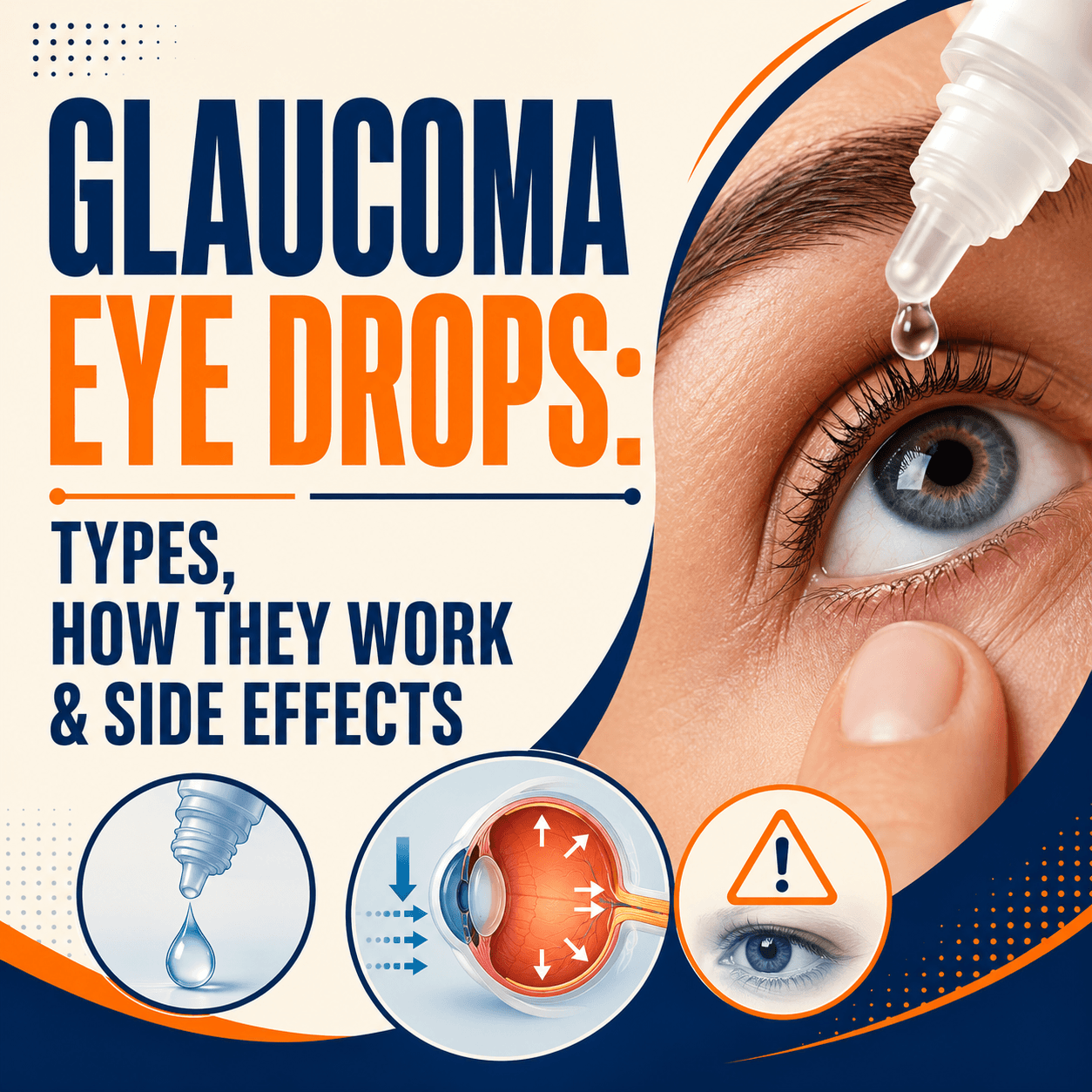




Latanoprost is one of the most widely prescribed glaucoma medicines in the world, and for good reason: one drop a day, a strong effect on eye pressure, and very little influence on the rest of the body.
It also produces changes people notice in the mirror: longer eyelashes, darker eyelid skin, sometimes an eye that looks subtly different from the other. Those changes are well recognised, and most of them are harmless.

Key Takeaway
Latanoprost eye drops lower pressure inside the eye by improving the drainage of fluid out of it. They are used once daily in the evening for open-angle glaucoma and ocular hypertension. Using them more often than once a day can make them work less well. The main side effects are local longer eyelashes and darkening of the iris and eyelid skin, rather than effects on the heart or lungs.
What Are Latanoprost Eye Drops?
Latanoprost belongs to a group of medicines called prostaglandin analogues. It is supplied as a 0.005% sterile eye drop and is prescription-only.
It is used to reduce raised intraocular pressure in:
- Open-angle glaucoma, the commonest form of the disease
- Ocular hypertension, where pressure is raised but no optic nerve damage has yet occurred
For most patients with open-angle glaucoma, a prostaglandin analogue is the usual first choice of treatment, largely because it is effective, needs only one dose a day, and has little effect elsewhere in the body.
How Latanoprost Lowers Eye Pressure
Your eye constantly produces a clear fluid called aqueous humour, which drains away through channels at the front of the eye. Pressure reflects the balance between how much is made and how much escapes.
There are only two ways to lower that pressure: make less fluid, or drain more of it.
Latanoprost works on drainage. It increases the outflow of fluid from the eye, so pressure falls. This is the opposite approach to beta-blocker drops such as timolol, which reduce how much fluid the eye produces.
Lowering pressure protects the optic nerve from further damage. It does not restore vision already lost, which is why treatment usually continues for life.
Why the Evening Dose, and Why More Is Not Better
Two instructions about this drug are unusual enough that they are worth understanding rather than just following.
Use it once daily, in the evening. That is the recommended dosing in the prescribing information, and it is not arbitrary; evening administration is the schedule the drug was studied and licensed on.
Do not use it more than once a day. This is the counterintuitive part. With most medicines, missing a dose and taking extra later is merely wasteful. With prostaglandin drops, using the drop more than once daily can actually reduce its pressure-lowering effect.
So:
- If you forget an evening dose, skip it and take the next one at the usual time. Do not use two drops the following evening.
- Do not add an extra morning drop because your pressure was high at your last visit. That decision belongs to your ophthalmologist.
- Do not use two different prostaglandin drops together. Combining them is not recommended.
Pick a fixed evening cue after brushing your teeth, before bed, and attach the drop to it. Consistency matters more than the exact hour.
Dosage and Storage
Follow the schedule your ophthalmologist has given you. For general orientation, the standard regimen is one drop into the affected eye or eyes, once daily in the evening.
Glaucoma treatment is usually lifelong. This is not a course that finishes, and your prescription may be adjusted as your pressure and optic nerve are monitored.
Storing Latanoprost in Indian Conditions
This drug has storage requirements that most eye drops do not, and they matter more in an Indian climate than in the countries where the guidance was written.
- Unopened bottles are stored refrigerated. Check your pack: if it says refrigerate, keep it in the fridge, not the door shelf where the temperature fluctuates.
- Once opened, the bottle may be kept at room temperature up to 25°C for six weeks.
That 25°C ceiling is the practical problem. Indoor temperatures across much of India exceed it for months at a time. If your room is warmer than that, keeping the in-use bottle in the fridge is the safer choice; take it out shortly before your evening dose so the drop is not uncomfortably cold.
Do not freeze it, keep it out of direct sunlight, and do not leave it in a car, a bag in the sun, or on a windowsill.
How to Use the Drops Correctly
- Wash and dry your hands.
- Remove contact lenses. They may be reinserted about 15 minutes after the drop.
- Tilt your head back and look up.
- Pull the lower eyelid down gently to form a small pocket.
- Squeeze in one drop. Do not let the nozzle touch your eye, lashes or fingers.
- Close the eye gently for a minute or two without squeezing or blinking hard.
- Press lightly on the inner corner of the eye beside the nose. This keeps more of the drop on the eye.
- Wipe away any excess that runs onto the eyelid or cheek with a clean tissue. This is worth doing routinely; see the eyelid section below.
- Leave at least five minutes between different eye drops.
If you use several glaucoma drops, ask your clinic to write down the order and the timing.
The Changes Patients Notice: Lashes, Iris and Eyelids
Latanoprost affects pigment and hair growth around the eye. These changes are expected, well documented, and mostly harmless, but they can be startling if nobody has warned you.
Eyelash and Hair Changes
Eyelashes on the treated side gradually become longer, thicker, darker and more numerous. Fine hairs on the eyelid skin may do the same.
Most people find this cosmetically acceptable or even welcome. Occasionally lashes grow in a misdirected way and rub against the eye, causing irritation; mention this if it happens, as it is easily managed.
These lash changes are usually reversible if the drug is stopped.
Iris Colour
Latanoprost can gradually increase the brown pigment in the iris. The label is clear that iris pigmentation is likely to be permanent, so this is the one change that does not reverse.
Three things are worth knowing, and they are more reassuring than the headline suggests.
It is not a growth process. The change comes from existing pigment cells producing more melanin, not from any increase in the number of cells. It is a colour change, not a lump or a tumour.
It is often not visible at all in dark brown eyes. The change works by brown pigment spreading outward from around the pupil across the iris. In a hazel or mixed-colour eye, that shift is obvious. In an iris that is already uniformly dark brown, as most Indian eyes are, there is frequently nothing to see.
It takes a long time. Any change may not be noticeable for several months, often years.
Freckles and moles in the iris are not affected. Treatment can usually continue even if pigmentation does develop, with regular examination.
Eyelid Skin and the Shape of the Eye Socket
Two further changes affect the tissue around the eye rather than the eye itself.
Eyelid skin can darken. This is usually reversible after stopping. Wiping away any drop that spills onto the lid or cheek reduces it, which is why that step is in the instructions above.
The upper eyelid crease can deepen, giving the eye a slightly more hollow or sunken appearance. This is a recognised effect of prostaglandin drops, reported after prolonged use. It develops slowly and is often reported to improve after stopping, though this is less predictable than the lash changes.
Neither affects vision. Both are worth raising with your ophthalmologist if they bother you, because alternatives exist.
When Only One Eye Is Treated
This is the situation that most often prompts a worried search.
If only one eye needs treatment, the changes appear only on that side. Over months, one eye may have visibly longer, darker lashes, slightly darker lid skin, and a marginally deeper lid crease than the other.
Nothing is wrong. It is the expected effect of the drug appearing on one side only.
If the asymmetry troubles you, say so at your next visit. Options exist, including switching to a different class of drop. It is a legitimate reason to discuss a change, not a vanity to be embarrassed about.
Other Side Effects
Commonly reported and usually mild:
- Redness of the eye, particularly in the early weeks; this often settles
- Stinging or burning as the drop goes in
- Blurred vision briefly after instilling
- A feeling of something in the eye
- Itching
- Fine surface dryness or irritation, which long-term use of preserved drops can contribute to; proper dry eye treatment can help if it becomes troublesome
Less commonly reported, including in postmarketing use:
- Inflammation inside the eye
- Swelling at the centre of the retina macular oedema which is more of a consideration in eyes that have had complicated surgery
- Corneal surface problems, including keratitis and corneal swelling
- Breathing symptoms including asthma or worsening of existing asthma, and breathlessness
That last point deserves an honest note. Latanoprost is far less likely to affect breathing than a beta-blocker eye drop, which is precisely why it is often chosen for people with asthma. But respiratory reactions have been reported, so tell your ophthalmologist about any lung condition, and report new breathing symptoms rather than assuming eye drops cannot be responsible.
When to Contact Your Doctor
Contact your ophthalmologist promptly if you develop:
- Eye pain
- Any reduction or distortion of vision
- Marked or increasing redness
- Sensitivity to light
- Lashes growing inward and rubbing the eye
Seek same-day care for severe eye pain with redness, haloes around lights, nausea and blurred vision, or a sudden loss of vision.
Latanoprost or a Beta-Blocker: Why You Were Given This One
Many patients arrive at latanoprost after being switched from timolol, or are given it first because timolol was unsuitable. The two work in opposite ways and have almost opposite side-effect profiles.
|
Latanoprost (prostaglandin analogue) |
Timolol (beta-blocker) |
|
|
How it lowers pressure |
Increases fluid drainage out of the eye |
Reduces fluid production in the eye |
|
Dosing |
Once daily, in the evening |
Usually once or twice daily |
|
Main side effects |
Local eyelash growth, iris and eyelid pigmentation, lid changes, redness |
Can affect the heart and lungs through absorption into the bloodstream |
|
Suitable in asthma or COPD |
Generally yes, with your doctor’s knowledge |
No, asthma and severe COPD are contraindications |
|
Suitable in heart rhythm problems or heart failure |
Generally yes |
No, these are contraindications |
If you have asthma, COPD, a slow heart rate or heart failure, this is very likely why you are on latanoprost rather than a beta-blocker. That is a deliberate and appropriate choice.
Who Needs Extra Caution
Tell your ophthalmologist before starting if you have:
- A history of inflammation inside the eye, such as uveitis or iritis
- Previous herpes infection of the eye
- Had complicated cataract surgery, or have no natural lens with a disturbed lens capsule
- Any lung condition, including asthma
- Contact lens wear, so you can be advised on timing
- Any known allergy to latanoprost or to benzalkonium chloride, the common preservative
Pregnancy and breastfeeding should be discussed with your doctor before starting or continuing.
When to See Your Eye Doctor
Keep every scheduled review. Glaucoma monitoring involves measuring eye pressure, examining the optic nerve, and testing your field of vision, none of which you can judge for yourself, because glaucoma causes no symptoms until it is advanced and any damage is permanent.
Book sooner if:
- Your eye has become persistently red, painful or light-sensitive
- Your vision has changed in any way
- Lashes are rubbing against the eye
- The appearance changes are distressing you
- You are struggling with the routine or cannot get a refill
- You have stopped the drops for any reason
A comprehensive eye examination is also how glaucoma is detected in the first place. Because it runs in families, close relatives of anyone with glaucoma should have their own pressures and optic nerves checked.
Conclusion
Latanoprost is an effective, convenient glaucoma treatment with an unusual advantage: because so little of it affects the rest of the body, it suits people whose asthma or heart condition rules out other options.
The two things worth getting right are simple. Take it once, in the evening, every day, and resist the instinct that more drops would help, because with this medicine more can mean less.
As for the changes you may notice in the mirror, most are harmless and many reverse. If any of them trouble you, or if your eye has become red, painful or your vision has changed, book an appointment rather than quietly stopping the drops. Glaucoma treatment only protects your sight while you are still using it.