


If your child’s spectacle power has increased at every visit, you have probably been told about atropine eye drops. It is one of the most discussed options in children’s eye care today and also one of the most misunderstood.
This guide explains what these drops are, how they are thought to work, what the research genuinely shows (including where it disagrees), the side effects to expect, and the questions worth asking your child’s eye specialist.
Key Takeaway: What Do Atropine Eye Drops Do for Myopia?
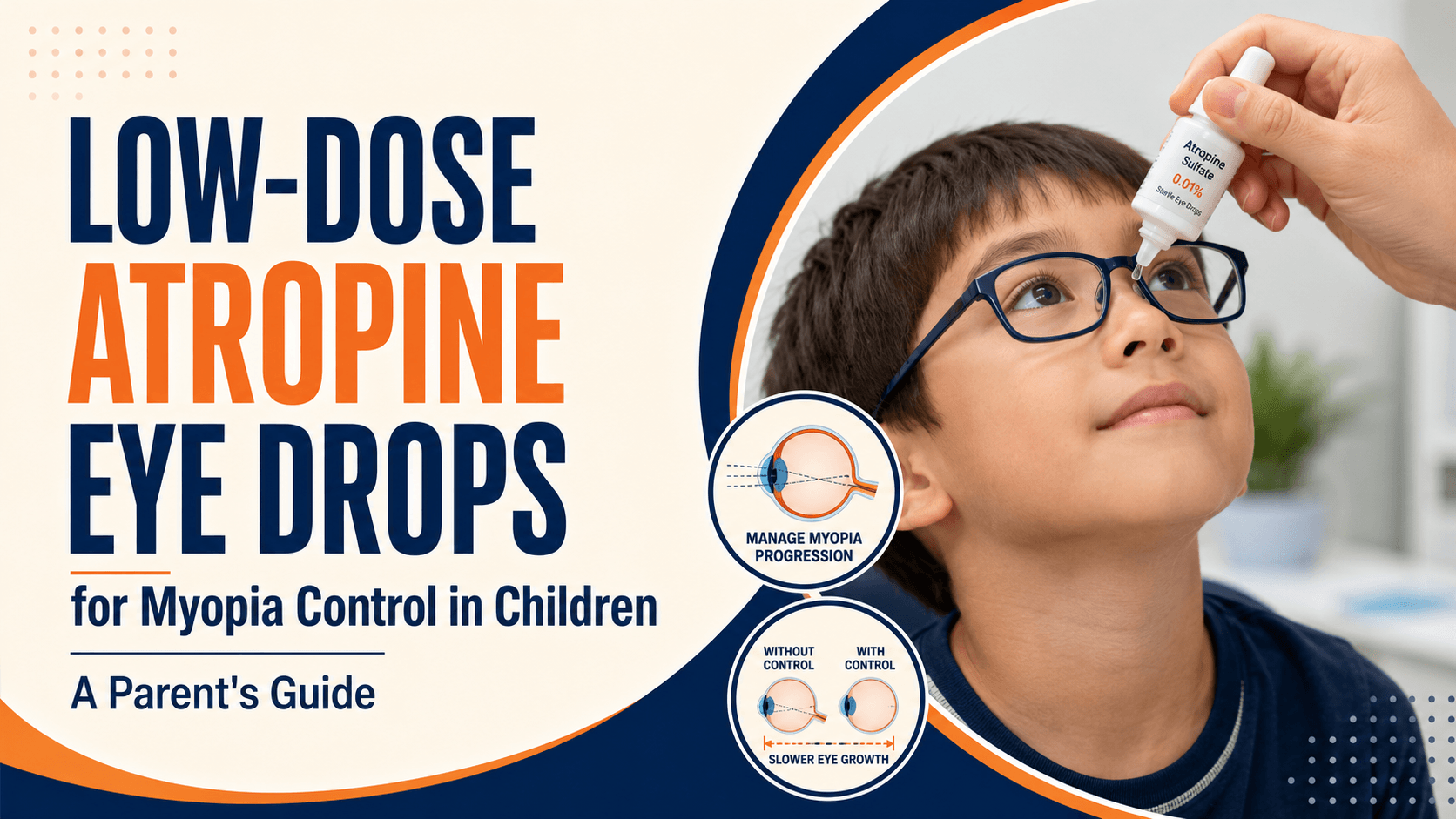
Low-dose atropine eye drops are a prescription treatment used to slow the progression of myopia (short-sightedness) in children. They do not cure myopia, reverse existing power, or remove the need for glasses. The goal is to limit how much worse the myopia becomes as the child grows, because higher myopia carries a higher lifetime risk of serious eye problems. The drops are usually given as one drop in each eye at bedtime, under an ophthalmologist’s supervision.
What Are Atropine Eye Drops?
Atropine is a medicine that blocks certain nerve signals in the eye. In eye care it has been used for many years, in different strengths, for several purposes:
- Dilating the pupil and relaxing focusing before a detailed eye examination, particularly in children, where an accurate spectacle power cannot be measured otherwise.
- Treating inflammation inside the eye (uveitis), where it eases pain and prevents scarring.
- Treating amblyopia (lazy eye) in selected cases, by blurring the stronger eye to encourage the weaker one to work.
- Slowing myopia progression in children is the focus of this article.
The critical difference is strength. The atropine used for dilation is typically 1%. The atropine used for myopia control is far weaker, usually 0.01% to 0.05%, which is 20 to 100 times more dilute. They are not interchangeable.
How Do Low-Dose Atropine Eye Drops Slow Myopia?
Myopia develops largely because the eyeball grows too long from front to back. Light then focuses in front of the retina instead of on it, so distant objects look blurred. The longer the eye grows, the higher the power becomes.
Low-dose atropine appears to slow this excessive lengthening of the eye. Researchers believe it acts on receptors in the retina and sclera (the white outer coat) that influence eye growth, rather than simply relaxing the focusing muscle as older theories suggested.
Being straightforward about the limits of current knowledge: the exact mechanism is still not fully understood. What the research measures is the outcome: how much the eye lengthens and how much the power changes over time.
Which Concentration Is Used: 0.01%, 0.025% or 0.05%?
Several low concentrations are used, and they behave differently. In general, higher concentrations within this low range control progression better but cause more noticeable side effects.
|
Concentration |
Typical effect on progression |
Side effects |
Notes |
|
0.01% |
Mildest; evidence is mixed |
Fewest, often barely noticeable |
The most widely used historically, but recent trials question its effect |
|
0.025% |
Intermediate |
Mild; some light sensitivity |
A middle option when 0.01% seems insufficient |
|
0.05% |
Strongest of the low doses in trial data |
More pupil dilation and near blur, but generally tolerated |
Best-performing concentration in the major dose-comparison trial |
Your child’s ophthalmologist chooses the concentration based on age, how fast the myopia is progressing, family history and how well your child tolerates the drop. It is common to adjust the strength over time rather than fix it at the start.
How Well Does It Work? What the Research Actually Shows
This is where honest reporting matters, because the evidence is genuinely mixed and you deserve to know that before starting a multi-year treatment.
Evidence supporting atropine
Early research used atropine 1%, which slowed myopia effectively but caused significant light sensitivity and blurred near vision, making it impractical for long-term use in children.
The most influential recent work is the LAMP study from Hong Kong, which enrolled 438 children aged 4 to 12 and compared 0.05%, 0.025% and 0.01% atropine against a placebo. It found a concentration-dependent response: the higher the concentration within this low range, the greater the effect, with 0.05% performing best. Longer follow-up over five years continued to favour 0.05%, with 0.025% next and 0.01% least effective.
The trial that found no benefit
In 2023, a randomised trial conducted by the Pediatric Eye Disease Investigator Group and funded by the US National Eye Institute reported a different result. It followed 187 American children aged 5 to 12 who used either 0.01% atropine or a placebo nightly for two years.
It found no significant difference between the two groups either in the degree of myopia or in the length of the eye. The National Eye Institute noted that this contradicts findings from trials conducted mainly in East Asia, and the researchers suggested that differences in how children of different ethnic backgrounds respond to atropine may partly explain the gap.
What this means for you as a parent is not that atropine does not work. It means that 0.01% specifically may be too weak for some children, and that treatment needs monitoring rather than assumption.
Evidence from India
Indian research is directly relevant here, since myopia progression rates and treatment response can vary between populations. Studies conducted in Indian children have examined low-dose atropine against placebo, and a randomised trial comparing 0.05% with 0.01% found the 0.05% concentration to be more effective at slowing both the increase in power and the lengthening of the eye. Side effects reported mainly difficulty with near vision and light sensitivity were mild and generally well tolerated.
This aligns with the international dose-response pattern and is a useful reference point when discussing concentration with your child’s doctor.
Side Effects of Atropine Eye Drops in Children
At low concentrations, side effects are usually mild and often settle as the child adjusts. The most common are:
- Light sensitivity (photophobia), because the pupil is slightly larger than normal
- Slightly blurred near vision, which can affect reading and close work
- Mild stinging when the drop goes in
- Redness or itching around the eye
Less commonly, some children develop an allergic reaction to the drop or the preservative. Very rarely, and more likely with stronger concentrations, atropine can cause effects elsewhere in the body such as dry mouth, flushing or a fast heartbeat.
Tell your child’s ophthalmologist promptly if your child develops persistent redness, swelling of the eyelids, a rash, marked difficulty reading, or any general unwellness after starting the drops. Do not simply stop or change the dose on your own.
Which Children May Be Suitable?
Not every child with glasses needs atropine. It is generally considered when:
- Myopia is progressing meaningfully year on year, rather than being stable
- The child is young at onset; early-onset myopia has more years left to progress
- There is a family history of high myopia
- The eye’s axial length is increasing on measurement
- The child and parents can manage a nightly drop consistently for a long period
Atropine is generally avoided or used with extra caution in children with certain eye or general health conditions, and in children who have shown a previous reaction to it. Suitability is a clinical decision made after a full examination including a cycloplegic refraction, which gives the true spectacle power in children. A paediatric ophthalmology assessment is the appropriate starting point.
What to Expect: Starting Treatment and Follow-Up
- Baseline assessment. A full eye examination, cycloplegic refraction to establish the accurate power, and ideally a measurement of axial length (the front-to-back length of the eye).
- Discussion of options. Your ophthalmologist explains atropine alongside the alternatives, and the expected duration of treatment.
- Starting the drops. Usually one drop in each eye at bedtime. Giving it at night means most of the near-vision blur and light sensitivity happens while your child is asleep.
- Early review. A follow-up in the first weeks to check tolerance and side effects.
- Regular monitoring. Reviews typically every six months, repeating the refraction and axial length measurement to see whether progression is genuinely slowing.
- Adjustment. If progression continues, the concentration may be increased or another method added. If it stabilises well, your doctor plans how and when to reduce treatment.
Treatment usually continues for at least two to three years, and often through the years when the eye is still growing. Atropine is not a short course.
A practical tip for putting drops in: have your child lie down and close their eyes, place the drop in the inner corner of the closed eye, then ask them to open. The drop rolls in without a struggle far more easily than fighting a resisting child at bedtime.
What Happens When Treatment Stops? Understanding Rebound
When atropine is stopped, myopia can progress faster again for a period. This is called the rebound effect.
Research suggests rebound is more pronounced with higher concentrations and in younger children, though in the long-term follow-up of the main dose-comparison trial, the rebound seen after stopping 0.05% was small enough to be considered clinically unimportant. Because of this, doctors often taper treatment gradually rather than stopping abruptly, and continue monitoring afterwards.
This is one reason atropine is a planned, supervised course rather than something to start and stop at home.
Other Myopia Control Options
Atropine is one tool among several, and they are sometimes combined. Standard single-vision glasses correct blurred vision but are not designed to slow progression.
|
Option |
How it works |
Points to consider |
|
Low-dose atropine drops |
Slows lengthening of the eye |
Nightly drop; needs monitoring; mild side effects |
|
Myopia control spectacle lenses |
Special lens designs that alter how light focuses in the peripheral retina |
Non-invasive; child must wear them consistently |
|
Orthokeratology (ortho-k) |
Rigid lenses worn overnight that temporarily reshape the cornea |
Glasses-free days; requires strict lens hygiene to reduce infection risk |
|
Soft multifocal contact lenses |
Daytime lenses that create peripheral defocus |
Suits older, responsible children; hygiene is essential |
|
More outdoor time |
Time outdoors is associated with slower myopia development |
Simple, free and worth doing regardless of other treatment |
Encouraging around two hours of outdoor time daily, and sensible limits on continuous close work and screens, supports any medical treatment your child receives.
Why Slowing Myopia Matters
Myopia is not only about thicker glasses. As the eye lengthens, its internal tissues stretch, and higher myopia is associated with an increased lifetime risk of serious conditions including retinal detachment, glaucoma, early cataract and damage to the macula.
Every dioptre of progression prevented in childhood slightly reduces that future risk. That is the real purpose of myopia control, not cosmetic, and not about avoiding glasses, but about protecting the eye’s long-term health. You can read more about myopia and how it is managed.
A Safety Warning: Never Buy Atropine Eye Drops Without a Prescription
This point deserves emphasis. The atropine eye drops most commonly stocked in pharmacies are atropine 1%, a strong dilating drop, not the low concentration used for myopia control.
Giving a child 1% atropine can cause prolonged pupil dilation, marked light sensitivity and blurred near vision lasting a week or more, and in a small child carries a risk of systemic effects. Low concentrations used for myopia control are specially prepared, and availability and formulation vary.
Atropine for myopia control should only ever be prescribed, dispensed and monitored by a qualified ophthalmologist. Do not source it online, reuse an old prescription, or copy another child’s treatment.
Conclusion
Low-dose atropine eye drops are one of the better-supported ways to slow myopia progression in children, but they are a supervised, long-term treatment rather than a quick fix. The evidence is strong enough to take seriously and mixed enough to warrant honest expectations: some trials show clear benefit, one major trial found none for the weakest concentration, and the current pattern points to higher low-doses working better.
What consistently helps every child is early detection and regular monitoring. If your child’s power has increased over the last year, or myopia runs in your family, arrange a proper paediatric eye assessment including axial length measurement where available and discuss whether myopia control is appropriate. You can book an appointment with an eye specialist to have your child evaluated.