



Applying kajal to a newborn is one of the most affectionate rituals in Indian family life. It is done out of love and protection, usually by a grandmother, and questioning it can feel like questioning the family itself.
This article is not about abandoning the tradition. It is about one specific part of it: putting kajal on or near a baby’s eyes and what eye doctors have learned about the risks.
Key Takeaway
Doctors advise against applying kajal, surma or kohl to a baby’s eyes or eyelid margins. The main concern is lead, which is found in many of these products and can harm a child’s developing brain even in small amounts. There is also a risk of eye infection and surface irritation. Labels such as “herbal”, “organic” or “chemical-free” do not guarantee a product is lead-free.
The Short Answer
No, kajal should not be applied to a baby’s eyes. This is the position of health authorities internationally, and it rests on two separate problems.
The first is lead. Many traditional eye cosmetics in this family kajal, surma, and kohl contain lead, sometimes in very large amounts. Lead is harmful to young children even at low levels of exposure.
The second is the eye itself. A baby’s eye surface is delicate and its tear drainage system is still maturing. Anything applied at the lid margin can introduce bacteria and irritate the surface.
The important point is that this is an avoidable exposure. Unlike lead in old paint, soil or water, this one is entirely within a family’s control.
Why Kajal Is Applied to Babies
The practice is old and it comes from genuine care. Families apply kajal because they believe it:
- Protects the baby from the evil eye or nazar
- Makes the eyes look bigger, darker and more expressive
- Cools or soothes the eyes
- Strengthens the eyes or improves eyesight
- Encourages thicker eyelashes
The protective intent behind it is real, and it deserves respect. The specific claims about the eyes, unfortunately, do not hold up.
What Kajal Cannot Do
- It does not make eyes grow bigger. Dark outlining creates a visual contrast effect. The eye itself is unchanged.
- It does not improve or strengthen eyesight. Vision develops according to the eye’s own growth and the brain’s visual pathways. No cosmetic influences that.
- It does not cool or soothe the eyes. If a baby’s eyes look irritated or watery, that is a reason to see a doctor, not to apply kajal.
- It does not prevent eye problems. Conditions such as squint, refractive error and blocked tear ducts are unaffected by it.
- It does not reliably grow lashes. Lash growth is determined by genetics and follicle health.
None of this diminishes the affection behind the ritual. It simply means the ritual does not need to involve the eyes.
The Main Concern: Lead
Traditional eye cosmetics sold under the names kajal, surma, kohl and several regional variants have been repeatedly found to contain lead, usually as lead sulfide.
The quantities involved are not trace contamination. The US Food and Drug Administration notes that lead sometimes accounts for more than half the weight of kohl products, and documents one product linked to infant lead poisoning that was found to be over 80% lead. A US public health investigation into two children with raised blood lead levels traced the source to a kajal used by the family that was more than half lead by content.
Levels vary enormously between products, and this is worth stating precisely rather than in alarm. A 2024 analysis published in Pediatrics examined 220 samples of traditional eye cosmetics collected during lead investigations. It found that surma and kohl samples mostly originating from Pakistan and Morocco contained extremely high lead levels, while the majority of samples labelled kajal, most of which came from India, had lead concentrations below the permissible limit.
That nuance matters, and it cuts both ways.
It means not every product is heavily contaminated. It also means you cannot tell which is which. The same word appears on products ranging from essentially lead-free to more than half lead. Nothing on the packaging distinguishes them, and no household test exists.
Why lead matters so much in babies:
- Young children absorb lead more readily than adults, and their brains are still developing
- Higher exposures are associated with anaemia, kidney problems and neurological damage
- Even low-level chronic exposure is associated with learning and behavioural difficulties
- The effects on brain development are not reversible
- Lead accumulates, so repeated daily application adds up over months
There is no established safe level of lead exposure for a child.
Why “Herbal”, “Organic” and “Homemade” Do Not Mean Lead-Free
This is the most common misunderstanding, and the marketing around baby kajal actively encourages it.
Lead is not a synthetic chemical. It is a naturally occurring mineral. A product can be entirely natural, plant-based, Ayurvedic, handmade, and free of parabens and still contain lead, because the lead comes from a mineral ingredient or from contamination during preparation, not from modern chemistry.
Traditional preparation is not a safeguard either:
- Some traditional recipes deliberately use lead-containing minerals for a deep black colour
- Homemade kajal prepared with soot from a lamp depends entirely on what the lamp, wick, oil and vessel contain
- Homemade preparations are not sterile and can pick up bacteria during making and storage
- Ingredients bought loose from a shop cannot be verified
“Natural” describes origin. It does not describe safety.
Infection and Damage to the Eye Surface
Even setting lead aside, applying any cosmetic at a baby’s lid margin carries risks.
- Infection. Kajal is applied with a finger or applicator, repeatedly, into a pot that is not sterile and is kept for months. Bacteria transfer easily to a baby’s eye, which can lead to conjunctivitis or eyelid infections such as a stye.
- Surface irritation. Particles sitting on the eye surface can cause redness, watering and discomfort. A baby cannot tell you that something is stinging.
- Corneal injury. Babies move unpredictably. A finger or applicator near the eye can scratch the cornea, and a scratch that becomes infected can progress to a corneal ulcer, which is sight-threatening.
- Tear drainage. A baby’s tear drainage channels are narrow and still developing. Adding pigment near the inner corner is best avoided.
Sharing a kajal pot between family members, or between an adult and a baby, adds another route for transmitting infection.
What Product Labels Do and Do Not Tell You
Baby kajal is marketed with reassuring language. It is worth knowing what each phrase actually establishes.
|
Label claim |
What it actually means |
Does it establish eye safety in a baby? |
|
“Dermatologically tested” |
Tested for skin reactions, usually on adult skin |
No. Skin testing says nothing about heavy metal content or safety at the eye margin |
|
“100% natural” / “herbal” / “Ayurvedic” |
Describes the origin of ingredients |
No. Lead is a natural mineral |
|
“Chemical-free” |
A marketing phrase with no regulatory definition |
No |
|
“Paraben-free” / “no artificial colours” |
Specific ingredients are absent |
No. Says nothing about lead |
|
“GMP certified” |
The manufacturing facility follows good manufacturing practice |
No. Relates to process, not to whether the product is safe in an infant’s eye |
|
“Ophthalmologist tested” |
Tested with eye-safety input |
Closer, but still not a safety guarantee for infants, and rarely specified for babies |
None of these claims is dishonest in itself. The problem is that none of them answers the question a parent is actually asking.
If you want certainty about lead content, that requires laboratory testing of the specific batch, which is not something a consumer can do.
Safer Ways to Keep the Tradition
For most families, the meaning of the ritual is the blessing and the protection, not the eyes specifically. That leaves several options that preserve it entirely.
- A small dot behind the ear. Widely practised already, and away from the eye completely.
- A dot on the sole of the foot. Another traditional placement in many families.
- A small mark on the cheek or forehead, well away from the eye area.
- Use a kaala teeka on clothing or a bracelet rather than on the skin, if the intent is protection from nazar.
- Keep photographs and celebrations as they are the ritual’s meaning does not depend on its placement.
If a family member is insistent, this framing usually helps: nobody is being asked to give up the tradition, only to move it a few centimetres. The blessing is unchanged. The eye is protected.
Whichever placement you choose, wash your hands first, do not share the pot with anyone else, and keep it away from the baby’s eyes and mouth.
If You Have Already Been Using Kajal
Most Indian families have, across generations. This is not a reason for guilt, and the practical steps are straightforward.
- Stop applying it to the eyes. This is the single most useful action, and its benefit begins immediately.
- Speak to your paediatrician if you have been applying it regularly over months, particularly if it was surma or a homemade or loose-bought preparation. Ask whether a blood lead test is appropriate for your child.
- Mention any symptoms you have noticed: irritability, poor appetite, constipation, unusual tiredness, or a delay in reaching developmental milestones. These are non-specific and usually have other causes, but they are worth reporting in this context.
- Have your child’s eyes examined if there has been redness, watering, discharge or rubbing.
- Keep the product out of reach, and do not pass it to other families.
Lead exposure is cumulative. Stopping now limits what accumulates from here.
Why Parents Reach for Kajal and What Actually Helps
Often kajal is applied because something about the baby’s eyes seems to need attention. Usually the underlying observation is worth acting on, just differently.
- “My baby’s eyes water constantly.” In infants, this commonly reflects a blocked tear duct, where the drainage channel has not fully opened. It often resolves on its own during the first year, sometimes with a simple massage technique your doctor can demonstrate. Kajal does not help and may worsen irritation.
- “There is sticky discharge in the morning.” This needs assessment. It may accompany a blocked tear duct or indicate infection, which requires proper treatment.
- “The eyes look small.” Eye size varies, and infant features change substantially over the first two years. This is cosmetic, not medical.
- “I want to protect the eyes.” Genuine protection is practical: keep sharp objects and hot liquids out of reach, avoid smoke exposure, ensure vaccinations are up to date, and have the eyes examined if anything looks unusual.
- “The eyes look misaligned.” Occasional drifting can be normal in very young babies, but persistent misalignment beyond a few months needs assessment by paediatric eye care, because early treatment matters.
When to See an Eye Doctor
Arrange an examination if your baby has:
- Persistent watering or discharge from one or both eyes
- Redness that does not settle within a day or two
- Frequent eye rubbing, or sensitivity to light
- Swelling of the eyelids
- An eye that consistently turns inward or outward after a few months of age
- Any concern following kajal use
Seek same-day care for a white or grey spot on the surface of the eye, a white reflection in the pupil in photographs, an obviously painful eye, or any eye injury. These need urgent assessment.
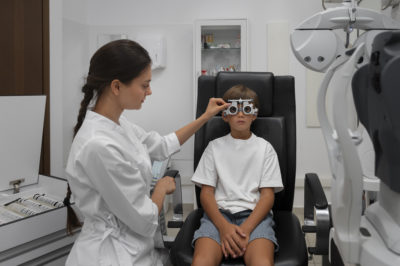
Vision problems in infancy are easy to miss because babies cannot report them, which is why other common childhood eye conditions are often picked up only at a routine check. A paediatric eye test can assess a baby’s eyes even before they can speak.
Conclusion
Kajal on a baby’s eyes is one of those practices where the intention is entirely loving and the evidence is entirely clear. Lead contamination is well documented across traditional eye cosmetics, cannot be identified from a label, and causes harm to a developing brain that cannot be undone. The infection risk is separate and additional.
The good news is how easy this one is to fix. The ritual, the blessing, and the protection can all continue behind the ear, on the foot, on the cheek. Only the placement changes.
If your baby has watering, discharge, redness, or anything else about the eyes that concerns you, that is worth a proper look rather than a cosmetic. Book an appointment with an eye specialist and have it checked.