



Search for ways to reduce eye power, and you will find eye exercises, yoga routines, diets, and drops, all promising freedom from glasses. The wish behind those searches is completely understandable.
The honest answer is less satisfying than the promises, but there is a genuinely useful answer underneath it, and for children it matters a great deal.

Key Takeaway
Existing eye power cannot be reduced or reversed by eye exercises, diet, yoga or any natural method. Short-sightedness is usually structural: the eyeball is longer than it should be, and nothing non-surgical shortens it. However, in children the rate of increase can be slowed using proven methods, and in adults power can be corrected surgically once it is stable.
The Short Answer
No, eye power cannot be reduced naturally. No exercise, food, supplement or routine has been shown to reverse an existing refractive error.
Two things can be done, and both are worth knowing:
- In children, the speed at which power increases can be reduced. This is called myopia control, and it works.
- In adults, power can be corrected with glasses, contact lenses, or surgery once the prescription has been stable.
Note the distinction, because it is the crux of the whole topic. Reducing power means changing the eye’s optics back. Correcting power means compensating for it. Only the second is possible.
Why Eye Power Cannot Be Reversed Naturally
To understand why, it helps to know what eye power actually is.
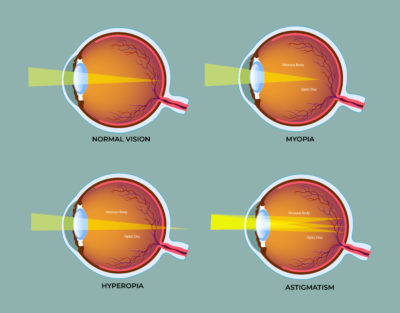
For the eye to see clearly, light must land exactly on the retina at the back. Short-sightedness, or myopia, means light focuses slightly in front of the retina instead. Distant objects blur.
The reason is usually anatomical: the eyeball has grown slightly too long from front to back. Sometimes the cornea is more curved than average. Either way, the mismatch is a matter of physical dimensions.
An eyeball that has grown longer does not shrink. There is no muscle you can train to shorten it, and no nutrient that reverses its growth.
This is why the focusing exercises so widely shared online cannot work as advertised. They train the focusing muscle inside the eye, which changes the lens shape for near work. That muscle has nothing to do with the length of the eyeball. Exercising it may briefly relieve tired eyes. It cannot alter your prescription.
Why Controlling Myopia Matters More Than the Glasses
Most people think of eye power as an inconvenience: glasses to carry, lenses to clean. For higher powers, there is a more serious dimension that is rarely explained.
As the eyeball elongates, the tissues at the back are stretched. High myopia substantially increases the lifetime risk of sight-threatening conditions, including retinal detachment, myopic macular degeneration and glaucoma. These are among the recognised causes of irreversible vision loss in populations where myopia is common.
This changes what the goal should be. For a child whose power is rising each year, the aim is not cosmetic. It is to limit how high that power ultimately climbs because a lower final power means lower lifetime risk.
That is why “can we reduce it?” is the wrong question, and “can we slow it down?” is the right one.
Myths and Facts: What Does Not Reduce Eye Power
|
Claim |
What is actually true |
|
Eye exercises reduce eye power |
They can ease tired eyes and help some focusing problems, but they do not change refractive error. Historically promoted exercise systems have not been shown to produce meaningful improvement in prescription |
|
Eating carrots improves eyesight |
Severe Vitamin A deficiency does cause eye problems, and correcting it matters. In a well-nourished person, extra Vitamin A does not reduce eye power |
|
Wearing glasses makes power worse |
Glasses do not increase power. Power rises because the eye is growing. Wearing the correct prescription does not accelerate this |
|
Going without glasses trains the eyes |
It does not. In children, leaving myopia uncorrected can interfere with visual development and school performance |
|
Eye yoga or palming can remove specs |
These may feel relaxing and can relieve strain. No evidence supports reversal of refractive error |
|
Screen time alone caused my power |
Myopia is driven by genetics, eye growth, prolonged near work and limited outdoor time together. Screens contribute to near-work load but are not the single cause |
|
Herbal or Ayurvedic drops reduce power |
No such preparation has been shown to change refractive error. Drops of unverified origin also carry contamination risk |
None of this means the habits are worthless. Several genuinely help with comfort; they just do not do what the headlines claim.
What Genuinely Works in Children: Slowing the Increase
This is the part missing from most articles on this subject, and it is the part that changes outcomes.
Myopia in children typically progresses as the eye grows, often through the school years. Progression can be slowed. Well-conducted trials support several approaches, and they are increasingly used in India.
Time Outdoors: The One Natural Measure With Real Evidence
If there is a natural intervention worth taking seriously, it is this.
Increased time outdoors has a protective effect against developing myopia in the first place. Studies of children commonly use a target of around two hours a day, and school-based programmes built on this principle have been adopted in several countries.
Two honest qualifications:
- The evidence is strongest for preventing myopia from starting. Once myopia exists, extra outdoor time appears to slow progression only modestly on its own.
- It works alongside other measures rather than replacing them. An Indian study of low-dose atropine found the treatment performed better in children who also spent more than two hours a day outdoors.
Outdoor time is free, has no side effects, and benefits a child in other ways. For any family asking what they can do without medication, this is the honest answer, and it is most valuable before myopia begins, which means younger siblings of a myopic child benefit most.
Medical Options for Myopia Control
These are prescribed and monitored by an eye specialist after assessment. They are not interchangeable, and suitability depends on the child’s age, power, rate of progression and lifestyle.
|
Approach |
What it involves |
Notes |
|
Low-dose atropine eye drops |
A very dilute drop, usually at night |
A well-studied pharmacological option. Concentration matters and response varies between children; requires specialist supervision and follow-up |
|
Myopia control spectacle lenses |
Glasses with specially designed lens zones |
Trials of these designs have shown consistent reductions in eye elongation compared with ordinary lenses. Worn like normal glasses |
|
Dual-focus soft contact lenses |
Daily disposable lenses designed for myopia control |
Effective in controlled studies. Requires a child able to handle lenses hygienically |
|
Orthokeratology |
Rigid lenses worn overnight that temporarily reshape the cornea |
Slows progression and gives clear daytime vision without glasses. Needs strict hygiene and regular review |
Newer approaches, including repeated low-level red-light therapy, are being studied and show early promise, but are not yet standard care.
Important context for parents: none of these reduces the power your child already has. They aim to limit how much further it rises. Starting earlier generally gives more benefit, which is why a rising prescription is worth acting on rather than waiting.
If your child’s power has increased noticeably at consecutive check-ups, that is the moment to ask about myopia control at a paediatric eye care consultation.
What Works in Adults: Correction, Not Reduction
Adult prescriptions usually stabilise by the early twenties. Existing power will not fall on its own, but it can be corrected.
- Glasses and contact lenses correct vision without altering the eye. Straightforward, reversible and suitable for everyone.
- Laser vision correction, including LASIK and related procedures, reshapes the cornea so light focuses correctly. Suitability depends on your prescription, corneal thickness and shape, tear film and general eye health.
- Lens-based surgery, such as an implantable lens, is an option for some people whose prescription or corneal characteristics make laser treatment unsuitable.
Whichever route, three points apply to everyone:
- Your prescription must be stable, generally for at least a year, before surgery is considered.
- Not everyone is a suitable candidate. A detailed pre-operative assessment determines this, and being told you are unsuitable is a safety finding, not a setback.
- Surgery corrects the focus; it does not undo the eye’s elongation. If you have high myopia, the retinal risks associated with it remain afterwards, and continued eye examinations are still needed. This is an important point that marketing rarely mentions.
Habits Worth Keeping Anyway
These will not lower your prescription. They do improve comfort and support eye health, which is reason enough.
- Follow the 20-20-20 rule: every 20 minutes of near work, look about 20 feet away for 20 seconds.
- Blink consciously during screen use. Blink rate drops substantially at a screen, which is the main driver of digital eye strain.
- Get children outdoors daily. The strongest natural lever available.
- Hold reading material at a comfortable distance rather than very close, and ensure decent lighting.
- Eat a varied diet with leafy greens, coloured vegetables and omega-3 sources. This supports general eye health rather than changing power.
- Wear your correct prescription, and update it when it changes.
- Protect your eyes from strong sunlight with UV-blocking sunglasses outdoors.
- Keep up regular eye examinations, especially if your power is high or rising.
When to See an Eye Doctor
Book an examination if:
- Your child’s power has increased at successive check-ups
- Your child is squinting, sitting close to screens, or complaining of headaches
- Your own vision has changed and your current glasses no longer feel right
- You are considering laser or lens surgery and want to know whether you qualify
- You have high myopia and have not had a dilated retinal check recently
Seek urgent care for a sudden increase in floaters, flashes of light, a shadow or curtain across part of your vision, or a sudden drop in vision. In high myopia these can indicate a retinal problem needing immediate attention.
A comprehensive eye test establishes your actual prescription, whether it is changing, and which options genuinely apply to you.
Conclusion
Eye power cannot be reduced naturally, and no amount of exercise, diet or routine will change a prescription that already exists. That is the honest answer, and knowing it saves time, money and disappointment.
What can be changed is the direction of travel. In children, myopia progression can be slowed with outdoor time and with proven medical options chosen after proper assessment and that matters because a lower final power means lower lifetime risk to the retina. In adults, vision can be corrected once the prescription is stable.
If your child’s power is climbing, or you are wondering whether surgery is an option for you, that is a question worth putting to a specialist. Book an appointment and get an answer based on your own eyes rather than a video.