


Almost everyone has stood six metres from a wall, covered one eye, and read letters that shrink line by line. Far fewer people understand what the result actually means when the doctor writes “6/9” or “6/6” on their card.
This guide explains how an eye test chart works, what the numbers mean, and the part most articles skip: what a good score does not tell you about your eyes.
Key Takeaway: What Does an Eye Test Chart Measure?
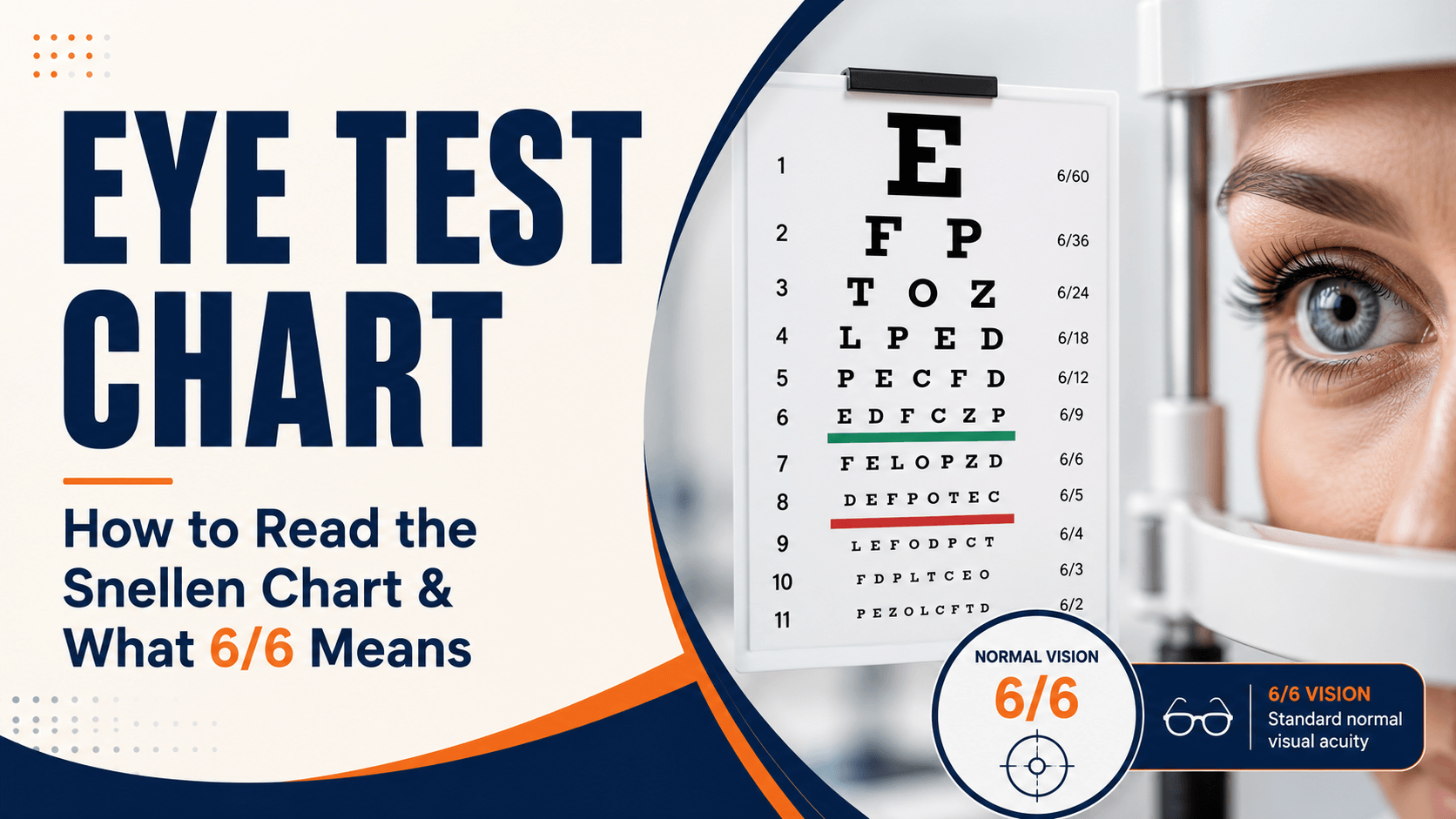
An eye test chart, most commonly the Snellen chart, measures visual acuity how clearly you can see detail at a set distance, usually 6 metres. A result of 6/6 means you can read at 6 metres what a person with normal vision reads at 6 metres. That is standard vision, not perfect vision. Crucially, the chart tests sharpness alone. A 6/6 result cannot rule out glaucoma, diabetic eye disease or other conditions that develop silently, which is why a chart test is only one part of a proper eye examination.
What Is an Eye Test Chart?
An eye test chart is a standardised display of letters, symbols or pictures that get progressively smaller down the chart. You read from a fixed distance, one eye at a time, and the smallest line you can read accurately gives your visual acuity score.
The best-known version is the Snellen chart, designed by the Dutch ophthalmologist Hermann Snellen in the 1860s and still in everyday clinical use. Its value is standardisation: because the letter sizes and testing distance are fixed, a result recorded in one clinic means the same thing in another.
The testing distance is not arbitrary. At 6 metres, light entering the eye is close enough to parallel that the eye muscles need not work to focus, so the test measures your vision rather than your focusing ability.
What Does 6/6 Vision Mean?
6/6 means that at 6 metres, you can read the line of letters that a person with normal vision can read at 6 metres. The first number is your testing distance; the second is the distance at which a person with standard vision could read that same line.
So the second number tells you the story:
- 6/6 – you read at 6 metres what a normal eye reads at 6 metres. Standard vision.
- 6/12 – you need to be at 6 metres to read what a normal eye reads at 12 metres. Your vision is reduced.
- 6/60 – you read at 6 metres only what a normal eye reads at 60 metres. Substantially reduced.
The bigger the second number, the poorer the acuity.
One widespread myth is worth correcting: 6/6 is not perfect vision. It is average, standard vision. Plenty of healthy young adults read 6/5 or even 6/4, meaning they see at 6 metres what an average eye needs to be at 5 or 4 metres to see. So 6/6 is a benchmark, not a ceiling.
Is 6/6 the Same as 20/20?
Yes. They are the same measurement in different units. India and the UK measure in metres, giving 6/6. The United States measures in feet, giving 20/20. Twenty feet is approximately six metres, so the two fractions describe identical vision.
The same applies down the chart: 6/9 equals 20/30, 6/12 equals 20/40, and 6/60 equals 20/200. If you have results recorded in both systems, and if you have been tested abroad, they are directly comparable.
How to Read Your Eye Test Result
Results are recorded separately for each eye, and usually both with and without glasses. “Unaided” means without correction; “aided” or “with correction” means wearing your glasses or lenses.
|
Metric (India/UK) |
US equivalent |
What it generally indicates |
|
6/5 or better |
20/15 |
Better than standard vision |
|
6/6 |
20/20 |
Standard normal vision |
|
6/9 |
20/30 |
Slightly below standard |
|
6/12 |
20/40 |
Mild to moderate reduction |
|
6/18 |
20/60 |
Moderate reduction |
|
6/24 |
20/80 |
Marked reduction |
|
6/36 |
20/120 |
Substantial reduction |
|
6/60 |
20/200 |
Only the top letter readable; the threshold used for severe visual impairment in many countries |
Two points of interpretation. A reduced score is not a diagnosis; it tells your doctor that something is limiting your sharpness, which may be a simple refractive error correctable with glasses, or something needing further assessment. And the comparison that matters most is with your own previous results, which is why keeping your old test cards is genuinely useful.
What If You Cannot Read the Top Letter?
If someone cannot read the largest letter at 6 metres, the test continues rather than stopping.
The examiner moves the person closer and records the distance. Reading the top letter at 3 metres is written as 3/60. If the top letter cannot be read even at 1 metre, vision is assessed in stages: counting fingers held up close, then hand movements, then perception of light and whether its direction can be identified, called projection of rays, and finally no perception of light.
These terms sound alarming written down, but they are simply a scale that allows very low vision to be measured and monitored accurately over time. They describe the measurement, not the outlook.
What an Eye Test Chart Cannot Tell You?
This is the most important section of this article.
A chart measures one thing: the sharpness of your central vision. It does not assess the health of your eye. You can read 6/6 comfortably and still have:
- Glaucoma – which damages peripheral vision first and is typically silent until advanced
- Diabetic retinopathy – which can be well established before central vision is affected
- Early macular changes, a retinal tear, or a developing cataract that has not yet reduced acuity
- Raised eye pressure, corneal disease, or optic nerve problems in an early stage
The chart also does not measure your peripheral vision, colour vision, depth perception, eye pressure, or how comfortably your two eyes work together.
The practical message: treat a good chart result as reassurance about your sharpness, not as a clean bill of eye health. Those are different questions and need different tests.
Types of Eye Test Chart
Different charts exist because not everyone can read Roman letters, and different situations need different precision.
|
Chart |
What it uses |
Best suited to |
|
Snellen |
Letters, decreasing in size |
Standard adult distance vision testing |
|
Tumbling E / Random E |
The letter E rotated in four directions |
Anyone who cannot read Roman letters: young children and people across different literacy and language backgrounds |
|
Landolt C |
A ring with a gap in one position |
Similar use to Tumbling E; common in research |
|
Picture or LEA symbol charts |
Simple shapes such as a house, apple or circle |
Young children |
|
LogMAR / ETDRS |
Five letters on every line, evenly spaced |
The research standard; more precise and reproducible than Snellen |
|
Near vision card (Jaeger / N-notation) |
Small print blocks held at about 40 cm |
Reading vision, particularly in presbyopia |
|
Ishihara plates |
Coloured dot patterns |
Colour vision testing, not acuity at all |
The Tumbling E deserves particular mention in the Indian context. Because the person only has to indicate which way the E points, it works regardless of whether they read English, which makes accurate vision testing possible for far more people than a letter chart alone.
LogMAR charts are more precise than Snellen because every line has the same number of letters and the spacing follows a consistent scale, which removes some of the inconsistencies built into the older design. Most clinics still use Snellen for routine testing, while LogMAR is standard in research and clinical trials.
How the Test Is Done Properly
Small details change the result, which is why a clinic test and a casual home attempt are not equivalent.
- Correct distance. Usually 6 metres, or a shorter room with a mirror arrangement that creates the same optical distance.
- One eye at a time, with the other properly covered, not squeezed shut, which can blur it temporarily.
- Adequate, even lighting on the chart, without glare or reflections.
- Glasses or lenses as instructed. The test is usually done both without and with your current correction.
- Reading down to the smallest line you can manage, being encouraged to attempt letters you are unsure about rather than stopping early.
- Recording each eye separately, and then both together where relevant.
If the result is below standard, the next step is refraction, the part where lenses are changed, and you are asked which is clearer to establish whether glasses can correct it. A visual acuity test is the starting point of an examination, not the whole of it.
Can You Use an Eye Test Chart at Home?
You can, as a rough screening check, but only if you understand its limits.
If you do use a printed chart:
- Print it at exactly the specified scale. A chart scaled even slightly wrong makes every result meaningless. Check the printed letter height against the stated measurement before using it.
- Use the exact distance the chart specifies. Standing closer makes the letters easier and produces a falsely good result.
- Light the chart well and evenly, with no glare.
- Cover one eye properly with your palm or a card, without pressing on the eye.
- Test with your usual glasses on, and again without, if you wear them.
- Do not use a phone or laptop screen for a distance chart, as screen size and brightness vary and the scale cannot be trusted.
What a home test can do is flag a difference between your two eyes, or a change from your last result, both worth reporting. What it cannot do is confirm your vision is fine, and it certainly cannot detect eye disease. A normal home result in someone with symptoms should never delay an examination.
What a Full Eye Examination Includes
A chart is one station in a much longer process. A comprehensive eye examination typically includes:
- Visual acuity for distance and near
- Refraction, to determine your spectacle prescription
- Slit-lamp examination of the front of the eye
- Tonometry, measuring eye pressure relevant to glaucoma
- Dilated retinal examination, to inspect the retina and optic nerve
- Visual field testing, where peripheral vision needs assessing
- Colour vision and eye alignment checks where indicated
- Scans such as OCT, where a closer look at the retina or optic nerve is needed
The tests that detect the serious, silent conditions are the ones after the chart. That is the argument for a proper examination rather than a quick vision check at a spectacle counter.
Vision Standards for Driving and Certain Jobs
Minimum vision standards apply to driving licences in India and for a range of occupations, including the armed forces, railways, aviation and some public service roles. Requirements differ by category and are periodically revised, and some specify colour vision or field of vision as well as acuity.
Because these standards change and vary by role, check the current official requirement for your specific licence or job rather than relying on a general figure, and have your vision formally assessed rather than self-tested if you need to meet one.
When to Book an Eye Test
Arrange an eye examination if you notice:
- Blurring at distance or near, or difficulty reading road signs
- A difference between your two eyes
- Frequent headaches or eye strain
- A child sitting close to the television, squinting, tilting their head, or struggling at school is worth a children’s eye assessment, since children rarely report poor vision themselves
- Any change from your previous result
As a general guide, adults with stable vision are advised to be examined every one to two years, with more frequent checks for anyone with diabetes, glaucoma in the family, high myopia, or existing eye conditions.
Seek urgent care rather than booking a routine test if you experience sudden vision loss, a curtain or shadow across your vision, sudden flashes with new floaters, eye pain, or double vision.
Conclusion
An eye test chart answers one question well: how sharply you see detail at a distance. Once you know that the first number is your testing distance and the second is the distance a normal eye would manage, your result stops being a code and becomes something you can track over the years.
The thing worth carrying away is what the chart leaves out. Reading 6/6 is good news about your sharpness and nothing more; it says nothing about your eye pressure, your retina or your optic nerve, and the conditions that quietly cost people their sight are precisely the ones a chart cannot see.
If it has been more than a couple of years since your last proper check, or you have noticed any change, book a comprehensive eye examination rather than relying on a chart alone.