


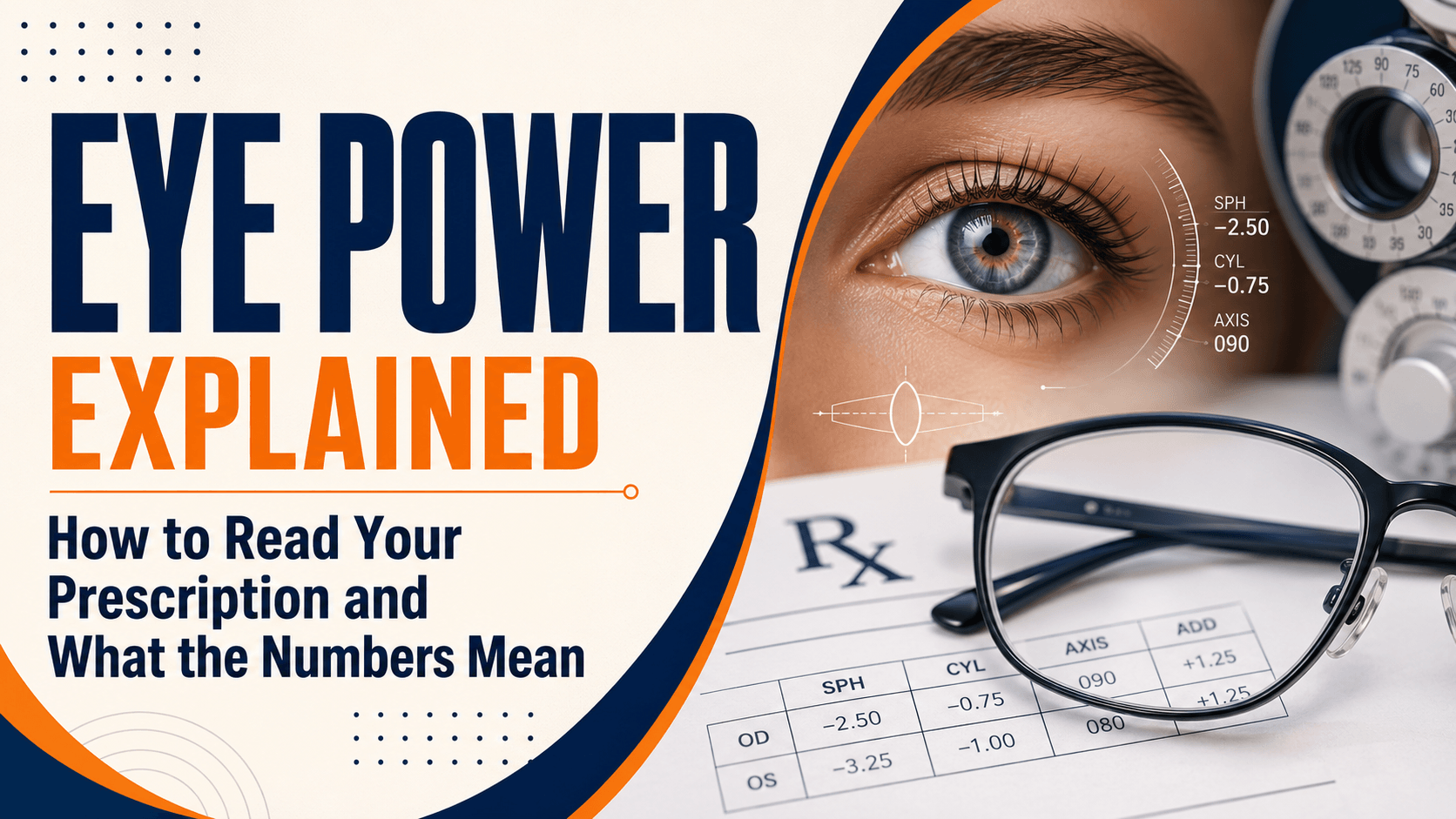
You collect your new spectacle prescription, glance at it, and see something like -2.25 / -0.75 x 90. Most people fold it up and hand it to the optician without ever understanding what it says about their eyes.
Your eye power is worth understanding. It tells you what kind of focusing error you have, how it is changing over time, and whether that change is routine or worth investigating.
Key Takeaway: What Is Eye Power?
Eye power is the strength of lens correction your eye needs to focus light sharply on the retina. It is measured in units called dioptres (D), usually in steps of 0.25. A minus number means short-sightedness (myopia), a plus number means long-sightedness (hyperopia), and a separate cylinder value indicates astigmatism. Eye power describes a focusing error, not an eye disease.
What Is Eye Power, Exactly?
For you to see clearly, light entering the eye must focus precisely on the retina at the back. When it focuses in front of or behind the retina instead, the image is blurred. That focusing error is what “eye power” describes.
Glasses and contact lenses correct this by bending light by a measured amount before it enters the eye. The size of that correction is your power, written in dioptres. The further your power is from zero, the stronger the correction you need.
One reassurance worth stating early: having eye power is extremely common and is not, by itself, a disease. It is a variation in how your eye focuses.
How to Read Your Eye Prescription
Prescriptions look cryptic because they use abbreviations and Latin. Here is what each column means.
|
Term |
Full meaning |
What it tells you |
|
OD |
Oculus dexter |
Right eye |
|
OS |
Oculus sinister |
Left eye |
|
OU |
Oculus uterque |
Both eyes |
|
SPH |
Sphere |
Main power minus for short-sight, plus for long-sight |
|
CYL |
Cylinder |
Amount of astigmatism correction needed |
|
AXIS |
Axis |
Orientation of the astigmatism, from 1 to 180 degrees |
|
ADD |
Addition |
Extra plus power for reading, used in presbyopia |
|
PD |
Pupillary distance |
Distance between your pupils, used to centre the lenses |
|
Prism / Base |
Prism correction |
Used when the eyes need help aligning |
Right eye and left eye
Prescriptions list each eye separately, because the two eyes rarely need identical correction. Some slips use “RE” and “LE” instead of OD and OS.
SPH (Sphere)
This is your main power. A minus sign (for example -3.00) means you are short-sighted and distant objects blur. A plus sign (for example +1.50) means you are long-sighted. If this box reads “Plano”, “Pl” or “0.00”, no spherical correction is needed.
CYL (Cylinder) and AXIS
These two always travel together. CYL is the amount of astigmatism in an unevenly curved cornea or lens that blurs vision at all distances. AXIS is simply the direction of that unevenness, written in degrees from 1 to 180.
The axis number is an orientation, not a strength. An axis of 180 does not mean worse vision than an axis of 10. If the CYL box is blank or shows 0.00, you have no significant astigmatism.
ADD (Addition)
This appears once presbyopia begins, usually after around age 40, when the eye’s natural lens becomes less flexible and near focus becomes difficult. ADD is the extra plus power for reading, and it is the same for both eyes in most prescriptions.
PD (Pupillary distance)
This measures the distance between the centres of your pupils in millimetres. It positions the optical centre of each lens correctly, and it matters more as your power increases.
A worked example
Take this prescription:
OD: -2.25 / -0.75 x 90 · OS: -2.00 / -0.50 x 85 · ADD +1.00
Read plainly, this person is mildly short-sighted in both eyes, slightly more so in the right. Both eyes have a small amount of astigmatism, oriented at 90 and 85 degrees. They also need a modest reading addition, which suggests they are around or past their early forties.
What Counts as Normal Eye Power?
“Normal” eye power is zero, written as 0.00 or “Plano”. This means the eye focuses light on the retina without help, a state called emmetropia. In practice, small amounts of power are very common and easily managed with glasses.
Two useful points of context:
- Young children are naturally slightly long-sighted. A small plus power in a young child is usually normal and often reduces as the eye grows.
- A “normal” power is not a health score. Someone with -5.00 D and healthy eyes may have better long-term eye health than someone with 0.00 D and glaucoma. Power and eye disease are different things.
Eye Power Chart: What the Numbers Mean
Clinicians group refractive error into broad bands. Definitions vary slightly between sources, so treat this as a guide rather than a rule.
|
Power range (spherical) |
Category |
What it usually means in daily life |
|
0.00 to ±0.50 D |
Negligible |
Often no glasses needed |
|
±0.50 to ±3.00 D |
Low |
Glasses helpful, especially for distance or reading |
|
±3.00 to ±6.00 D |
Moderate |
Glasses or lenses needed for most activities |
|
Beyond -5.00 to -6.00 D |
High myopia |
Regular retinal monitoring advised |
For short-sightedness, high myopia is generally defined at around -5.00 D or -6.00 D, depending on which definition is used. The World Health Organization adopted -5.00 D in 2015, while many research studies use -6.00 D.
Is 6/6 Vision the Same as Zero Power?
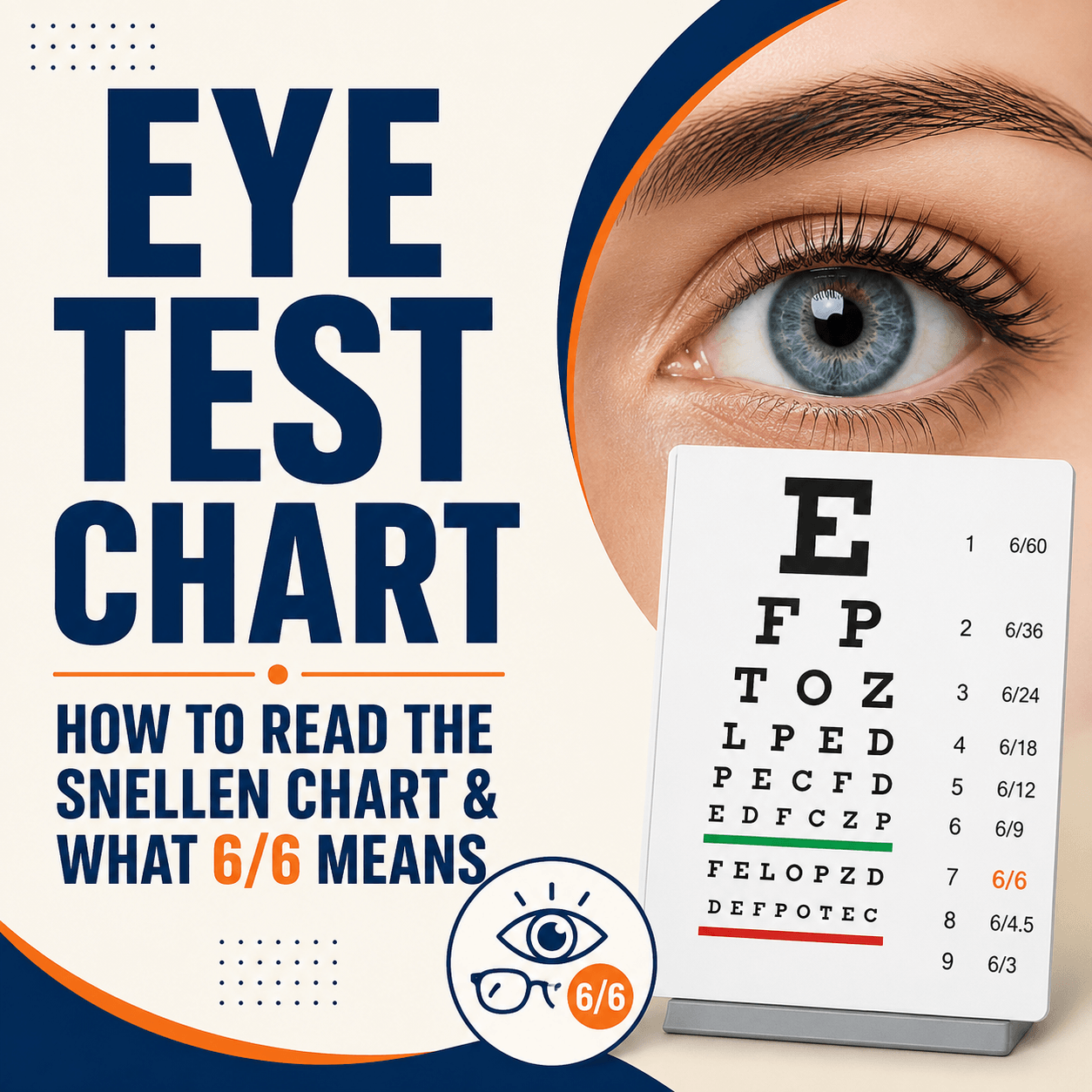
No. These measure two different things. Eye power (in dioptres) is the lens correction your eye needs. Visual acuity (6/6, or 20/20) is how clearly you can read a chart at a set distance.
Someone with -4.00 D can read 6/6 comfortably while wearing their glasses. Equally, a person may have zero power but reduced acuity because of a corneal, retinal or optic nerve problem.
So 6/6 describes performance, while zero power describes focusing. Being told your vision is 6/6 with glasses is good news; it does not mean your power has gone.
The Four Common Types of Refractive Error
|
Type |
Common name |
What blurs |
How it appears on a prescription |
|
Myopia |
Short-sightedness |
Distance vision |
Minus SPH, e.g. -2.50 |
|
Hyperopia |
Long-sightedness |
Near vision, sometimes distance too |
Plus SPH, e.g. +1.75 |
|
Astigmatism |
— |
All distances, slightly distorted |
CYL and AXIS values |
|
Presbyopia |
Age-related near difficulty |
Near vision after roughly 40 |
ADD value |
You can read more about myopia and how it is managed and about hyperopia. Having more than one at the same time is entirely normal short-sightedness with astigmatism is a very common combination.
Why Eye Power Changes at Different Ages
Eye power is not fixed for life. It usually follows a pattern.
- Childhood and teenage years. As the eyeball grows, short-sightedness often appears and increases. Power changes fastest during these years, which is why children need regular checks and why children’s eye assessments matter.
- Twenties and thirties. Power usually stabilises for most people.
- Around forty and beyond. Presbyopia begins, and a reading addition appears even in people who have never needed glasses before.
- Sixties onward. A developing cataract can shift power, often towards the minus side.
Increased near work and reduced outdoor time are associated with the rising rate of childhood myopia, which is why time outdoors is widely encouraged for children.
Can Eye Power Be Reduced Naturally?
This deserves a direct answer, because a great deal of misleading content exists on this topic.
No exercise, diet, massage or home remedy has been shown to reverse existing eye power in adults. A 2023 systematic review and meta-analysis published in the journal Eye examined controlled trials of eye exercises and concluded they have limited to no efficacy in preventing or controlling myopia progression.
What is supported by evidence falls into two categories.
In children, progression can often be slowed. Options with reasonable evidence include increased outdoor time, low-dose atropine eye drops, myopia control spectacle lenses and orthokeratology. These slow how fast power increases. They do not remove the power a child already has.
In adults, power can be corrected but not cured. Glasses and contact lenses correct it temporarily. Refractive surgery such as LASIK, or lens-based procedures, can reduce dependence on glasses but suitability depends on your power, corneal thickness, age and overall eye health, and outcomes vary between individuals.
One important caution: if your near vision suddenly seems to improve in your sixties or seventies, so that you can read without glasses again, this is usually not a sign of recovery. It can be “second sight”, a temporary shift caused by a developing cataract. It is a reason to have your eyes examined.
Which Eye Power Is Considered High Risk?
No spectacle power is dangerous in itself, and glasses do not become unsafe at any number. The real issue is that higher degrees of short-sightedness are associated with a higher lifetime risk of certain eye conditions, because the eyeball is longer and its internal tissues are more stretched.
In high myopia, generally around -5.00 D to -6.00 D or more, the recognised associations include:
- Retinal detachment and retinal tears
- Glaucoma
- Earlier cataract
- Myopic maculopathy, affecting the central retina
Two things are worth keeping in perspective. This is an increase in risk, not a certainty; most people with high myopia do not develop these conditions. And the risk rises gradually rather than switching on at a threshold, so even moderate myopia carries some increased risk compared with zero power.
The practical response is monitoring rather than worry. If your power is high, have a dilated retinal examination at the interval your ophthalmologist recommends, and report any sudden flashes, new floaters or a shadow in your vision immediately.
When a Change in Eye Power Needs Medical Attention
Gradual, small changes are normal. See an eye specialist promptly if you notice:
- A sudden change in vision or power
- Power that changes repeatedly over a short period in adulthood, which can occur with fluctuating blood sugar in diabetes
- A rapidly increasing cylinder value, or distortion that glasses no longer correct well, which can indicate a corneal condition such as keratoconus
- Blurring in one eye only
- Vision that stays blurred even with an up-to-date prescription
- Power change together with headaches, eye pain, halos around lights, double vision, flashes or a sudden increase in floaters
These features suggest something beyond a routine refractive change, and deserve an examination rather than simply a new pair of glasses.
How Eye Power Is Measured
An eye power test is quick and painless, and usually combines several steps.
- Visual acuity test. Reading a chart to measure how clearly you see.
- Autorefraction. A machine gives an approximate starting power.
- Retinoscopy. The examiner shines a light into the eye and observes the reflex to estimate power objectively, particularly valuable in children and anyone who cannot easily describe what they see.
- Subjective refraction. The familiar part, where lenses are changed and you are asked which is clearer. This fine-tunes the final prescription.
- Cycloplegic refraction where needed. Drops relax the focusing muscle so the true power can be measured. This is standard in children, whose strong focusing ability can otherwise mask long-sightedness.
- Eye health examination. Checking the front of the eye, eye pressure and the retina, because a prescription check should never be only about numbers.
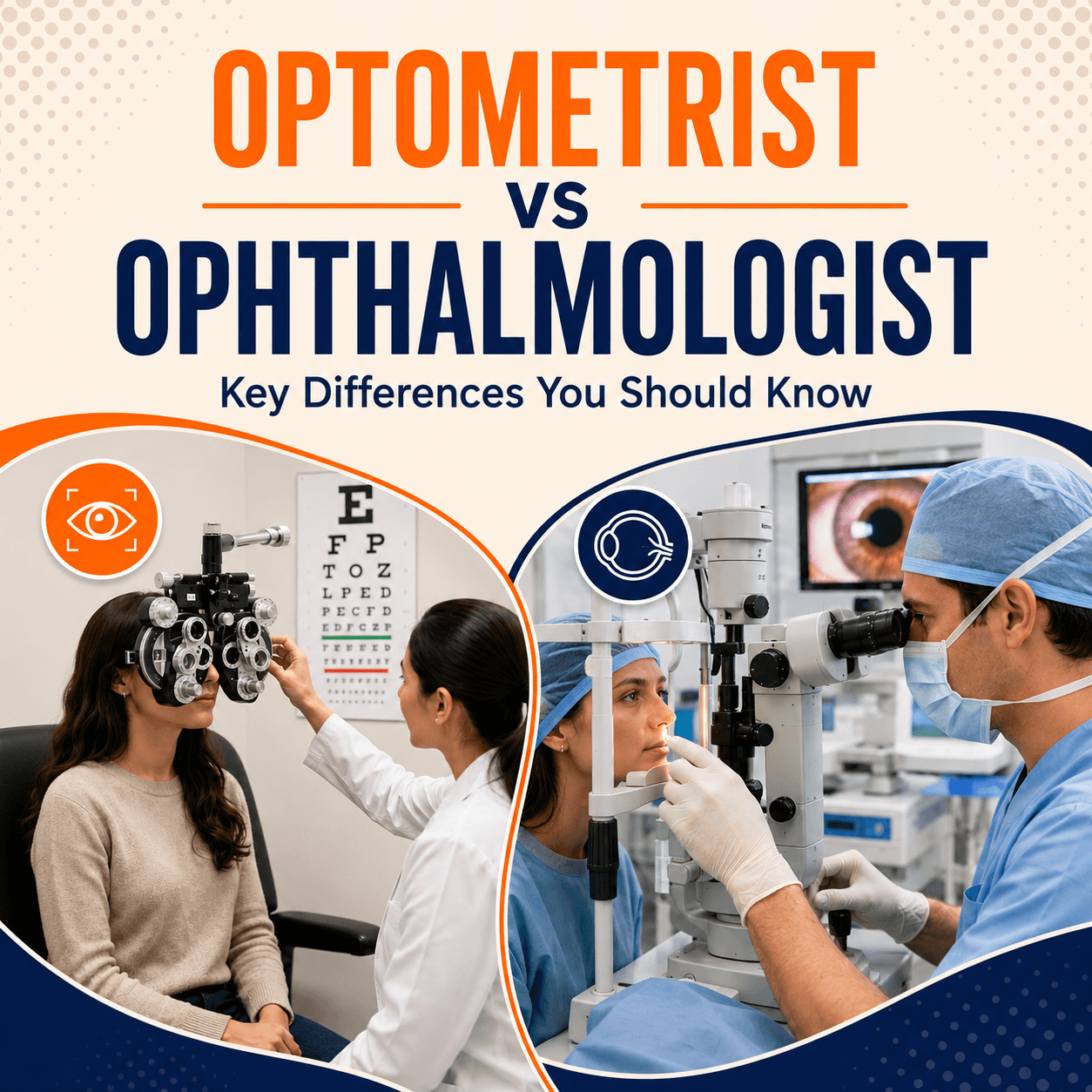
A comprehensive eye examination covers all of this. A power check at an optical shop measures the prescription but does not assess eye health.
Conclusion
Your eye power is simply a measurement of how your eye focuses, written in dioptres. Once you can read the sphere, cylinder, axis and addition values, your prescription stops being a mystery and becomes a record you can follow over the years.
Two ideas are worth carrying away. Power and eye health are separate: a high number is not a disease, and a low number is not a clean bill of health. And the pattern of change matters more than any single reading: gradual shifts are expected, while sudden changes, rapidly increasing astigmatism, or blurring that glasses no longer fix all deserve proper examination.
If your power has changed recently, or it has been more than a couple of years since your last check, book an appointment for a full eye examination rather than only a refraction test.