



You narrow your eyes at a road sign, a menu board, or the small print on a packet, and for a moment, it sharpens. Almost everyone does it. Almost nobody stops to ask why it works, or what it means that they needed to.
Squinting is not a bad habit. It is a clue. This guide explains the surprisingly precise optics behind it, what it usually indicates, and when it is worth acting on.
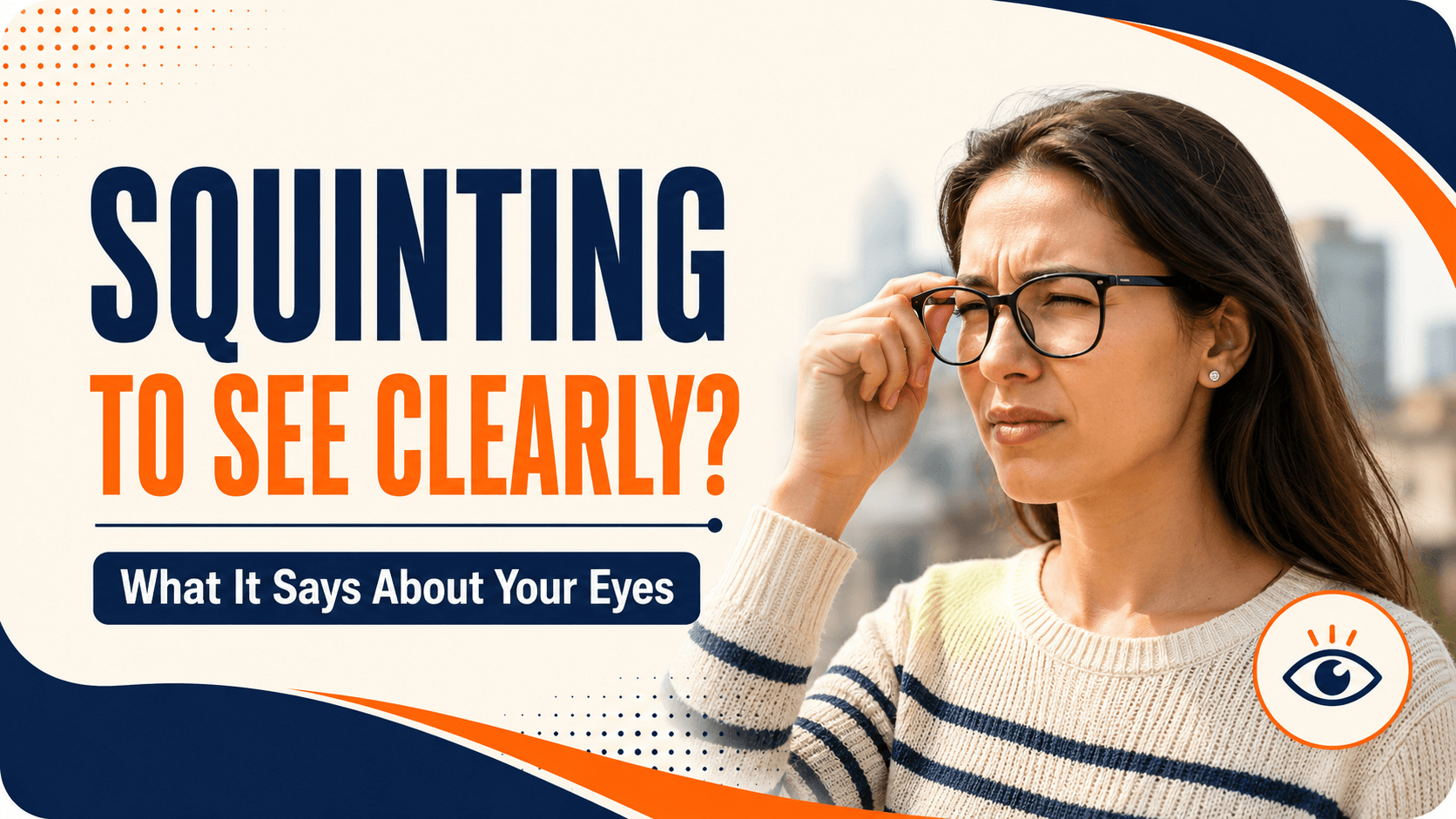
Key Takeaway: What Does Squinting to See Clearly Mean?
Squinting your eyes to see more clearly usually means you have an uncorrected refractive error, most often short-sightedness, astigmatism or age-related reading difficulty. Narrowing the eyelids creates a “pinhole effect” that temporarily sharpens a blurred image, but it does not change your eyesight and the effect disappears the moment you stop. Squinting does not damage your eyes, though it commonly causes eye strain and headaches. If you squint regularly, or your child does, it is a reason to have your vision tested.
Two Different Things Are Called “Squinting”
Before going further, one point causes constant confusion in India, and it is worth clearing up immediately.
- Squinting (the behaviour) means narrowing your eyelids to see better. It is something you do, usually without noticing, and it points to blurred vision.
- A squint (the condition), also called strabismus, means the two eyes are not aligned; one may turn inward, outward, up or down. It is something you have, and it is a medical condition affecting eye alignment.
They sound almost identical and mean entirely different things. This article is about the first. If you are looking for information on misaligned eyes, our page on squint and strabismus covers that condition, its causes and its treatment.
Why Squinting Makes Things Look Clearer: The Pinhole Effect
The mechanism is genuinely elegant, and understanding it explains everything else in this article.
When you narrow your eyelids, you shrink the opening through which light reaches your eye. Light entering an eye with a refractive error does not all come to a neat point on the retina; the rays arriving from the edges are the most badly focused, and they spread the image into a blurred circle.
Narrowing the aperture blocks those peripheral rays. Only the central, better-focused rays get through. The blur circle on the retina shrinks, contrast improves, and the image looks sharper. Narrowing the opening also increases the eye’s depth of focus, meaning a wider range of distances stays acceptably sharp, for the same reason a camera set to a small aperture keeps more of the scene in focus.
This is exactly what a pinhole occluder does. During an eye examination, your doctor may ask you to look through a small card punched with tiny holes. If your vision improves through it, that strongly suggests the problem is a refractive error that glasses can correct, rather than a disease of the retina or optic nerve. Squinting is your face performing the same test, informally, dozens of times a day.
Two limits are worth knowing. Squinting does not change your eyes at all; your corneal curvature, lens and prescription are identical whether you squint or not, and normal vision returns the instant you stop. And it works far less well in dim light, when the pupil is already wide and there is little light to spare.
What Squinting Eyes Usually Mean
If you find yourself squinting regularly, something is making your vision blurred. The usual causes are all correctable.
Short-sightedness (myopia)
The most common reason, particularly in younger people. Distant objects blur while near vision stays clear, so squinting tends to happen at road signs, whiteboards, screens across a room, or faces at a distance. Myopia is increasingly common in India, especially among school-age children and young adults.
Astigmatism
Caused by an unevenly curved cornea, which scatters light rather than focusing it to a single point. Astigmatism blurs vision at all distances and often produces a slight ghosting or stretching of letters and lights. People with astigmatism frequently squint without realising it, because the improvement is subtle but constant.
Long-sightedness (hyperopia)
With hyperopia, the focusing effort needed for near work is higher, so reading and close tasks bring on squinting, frowning and tired eyes, often more noticeably at the end of the day.
Age-related reading difficulty (presbyopia)
From around the forties, the eye’s natural lens stiffens and near focus becomes harder. The classic signs are holding a phone further away and squinting at small print in restaurants. The pinhole effect helps briefly, which is why people squint at menus before they accept they need reading glasses.
Cataract
In older adults, a clouding lens scatters light, reducing contrast and clarity. Squinting may help slightly at first, and people often notice they need more light to read. If squinting has increased alongside glare at night or faded colours, a cataract assessment is appropriate.
Prolonged screen work can also cause temporary blurring and squinting through digital eye strain, though this usually settles with breaks rather than persisting.
Is Squinting Bad for Your Eyes?
No. Squinting does not damage your eyes, worsen your prescription, or cause permanent harm. This is worth stating plainly, because many people worry that squinting is making their eyesight deteriorate. It is not the cause; it is the response.
It does have real downsides:
- Eye strain and fatigue, especially over a long day of reading or screen work
- Headaches and aching across the brow and temples from sustained facial muscle tension
- A narrowed field of view while you are doing it
- Reduced effectiveness in dim light, exactly when you often need it most
- Delayed diagnosis is the most significant cost, because squinting masks a problem well enough that people postpone getting tested for years
The frown lines question comes up often. Repeated facial expression contributes to skin creasing over time in general, but that is a cosmetic matter and not an eye-health one.
Squinting in Children: What Parents Should Watch For
This is the most important section for parents, because children almost never say their vision is blurred. They have no basis for comparison; they assume everyone sees what they see. What they do instead is adapt, and squinting is one of the clearest outward signs.
Watch for a child who:
- Narrows their eyes at the television, a whiteboard or distant objects
- Sits unusually close to screens or holds books very near the face
- Tilts or turns their head to look at things
- Rubs their eyes frequently, or complains of headaches
- Blinks excessively during reading
- Has slipping school performance, particularly with copying from the board
- Loses their place while reading, or avoids reading altogether
Any of these warrants a proper children’s eye assessment. Uncorrected refractive error in children is straightforward to correct with glasses, but left undetected it can affect learning and, in some cases, the development of vision itself.
A child squinting is not being dramatic or seeking attention. They are compensating.
Squinting in Bright Light Is a Different Problem
Narrowing your eyes in strong sunlight is normal; it is simply light regulation, and everyone does it.
What is not normal is persistent or disproportionate light sensitivity, called photophobia. If bright light causes genuine discomfort, or you find yourself squinting indoors or in ordinary daylight, possible causes include dry eye, corneal surface problems, inflammation inside the eye, migraine, and occasionally the aftermath of an eye procedure.
Light sensitivity with eye pain, redness, or reduced vision needs prompt assessment rather than sunglasses.
Squinting vs Squint (Strabismus)
|
Feature |
Squinting (the behaviour) |
Squint / strabismus (the condition) |
|
What it is |
Narrowing the eyelids to see better |
Misalignment of the two eyes |
|
What you notice |
Blurred vision, straining to focus |
One eye turning in, out, up or down |
|
Who notices it |
Usually you |
Usually other people |
|
Common cause |
Uncorrected refractive error |
Eye muscle or nerve imbalance, or high refractive error |
|
Typical treatment |
Glasses, contact lenses or refractive surgery |
Glasses, exercises, prisms, botulinum toxin or squint surgery |
|
Can it be present without blurred vision |
No |
Yes |
The two can occur together. A child with significant uncorrected long-sightedness may develop an inward-turning squint precisely because of the focusing effort involved, which is one reason a child who squints in either sense should be examined properly rather than watched.
What Happens at Your Eye Test
Finding out why you squint is quick and painless.
- Visual acuity testing on a chart, each eye separately, to measure how clearly you see.
- The pinhole test, where relevant the formal version of what you have been doing by squinting, used to establish whether glasses are likely to help.
- Refraction, where lenses are changed, and you are asked which is clearer, to determine your prescription.
- Slit-lamp examination of the front of the eye, including the cornea and lens.
- Eye alignment and movement checks, which also screen for a true squint. Our squint test page explains this assessment in more detail.
- Eye pressure and a retinal examination, since a chart test alone cannot rule out silent eye disease.
In children, drops are usually used to relax the focusing muscle so the true prescription can be measured, because a child’s strong focusing ability can otherwise hide long-sightedness entirely.
How Squinting Is Treated
Strictly speaking, squinting is not treated. The blurred vision causing it is, and the squinting stops on its own once vision is clear.
- Glasses are the simplest and most common solution, and for children usually the only one needed.
- Contact lenses suit many adults who prefer not to wear glasses.
- Refractive surgery such as LASIK may be an option for suitable adults with a stable prescription, though suitability depends on your eyes and outcomes vary.
- Cataract surgery, where a cataract is the underlying cause.
- Screen habits and lighting: regular breaks, adequate lighting and an up-to-date prescription reduce strain-related squinting.
There is no exercise or supplement that removes the need for correction. If you are squinting because your vision is blurred, correcting the blur is what stops it.
When to See an Eye Doctor
Book an eye examination if:
- You squint regularly to read signs, screens or small print
- You get headaches or eye strain after visual tasks
- Your child shows any of the signs listed earlier
- You are over 40 and holding things further away to read
- You notice increasing glare, halos at night, or faded colours
- Your last eye test was more than one to two years ago
Seek prompt medical attention instead of a routine appointment if squinting comes with sudden vision loss, eye pain, double vision, a shadow or curtain across your vision, or flashes with a sudden increase in floaters; these suggest something needing urgent assessment.
Conclusion
Squinting is your eye taking a shortcut. By narrowing the aperture it temporarily sharpens a blurred image, using the same optical principle your ophthalmologist applies deliberately with a pinhole occluder. It is harmless in itself, and it works well enough that people rely on it for years.
That reliance is the real issue. Squinting does not fix anything; it hides something, usually an easily correctable refractive error, and in older adults sometimes a cataract. In children it is one of the few visible signs of a problem they will never think to mention.
If you or your child squint regularly to see clearly, book an eye examination. In most cases, the answer is a simple prescription, and the difference between straining to see and simply seeing is larger than people expect.