



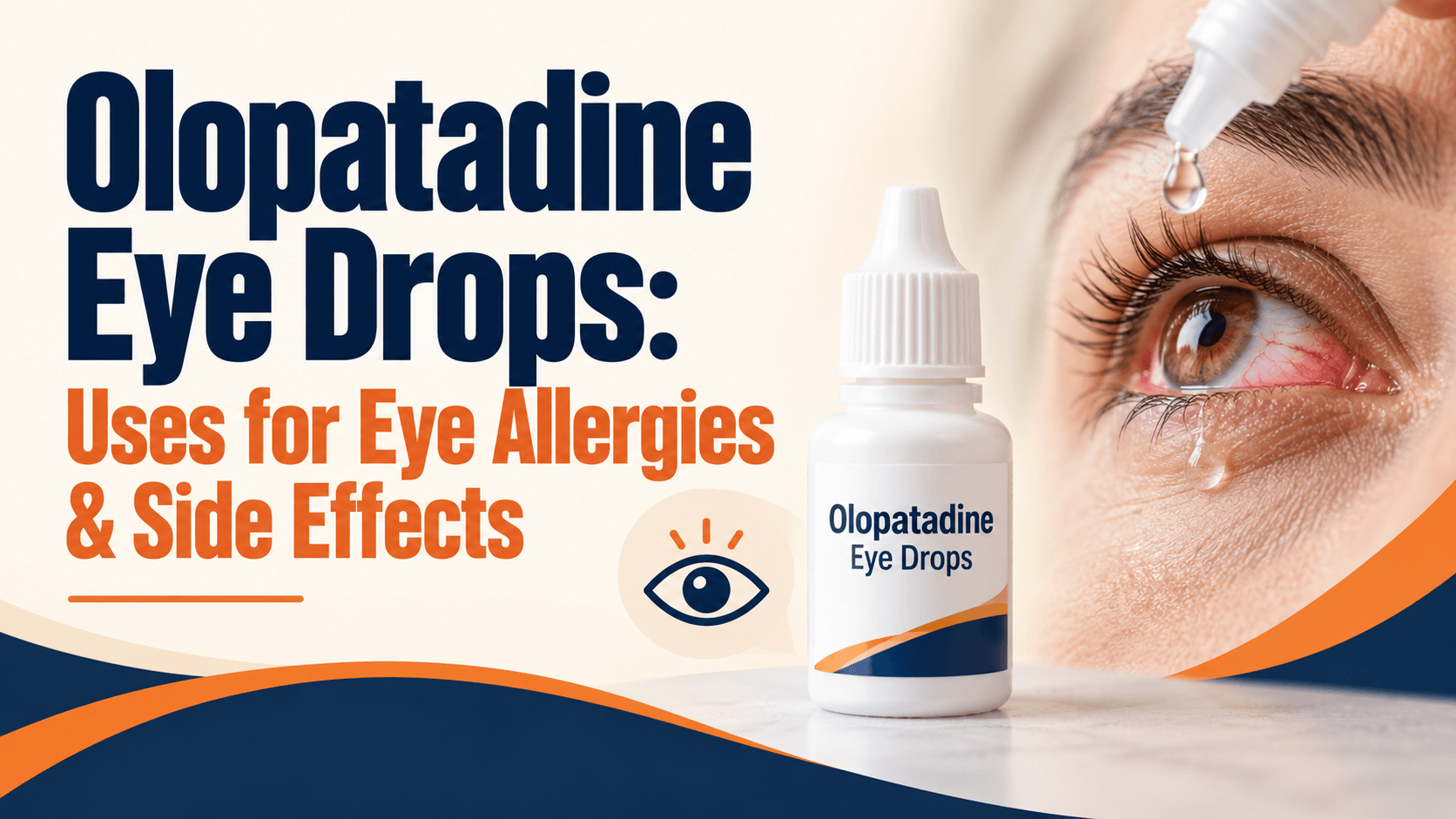
If your eyes itch every year at roughly the same time, or every time you clean a dusty cupboard, olopatadine is probably the drop you have been prescribed.
It is one of the most widely used anti-allergy eye medicines in India and it works considerably better if you understand when to start it.
Key Takeaway
Olopatadine eye drops treat the itching, redness, and watering caused by eye allergy. They work in two ways: blocking histamine for fast relief, and stabilising the cells that release it, which prevents symptoms building. Because of that second action, starting before or early in your allergy season works better than waiting until your eyes are already streaming.
What Are Olopatadine Eye Drops?
Olopatadine is an anti-allergy eye drop, supplied as a sterile solution in several strengths. The lower concentration is typically used twice a day; higher-strength versions are designed for once-daily use.
In India it is sold under several brand names, and many patients know it only by the name on their bottle. If your pack lists olopatadine or olopatadine hydrochloride as the active ingredient, it is the same medicine regardless of the brand.
Two Actions in One Drop
Most allergy medicines do one job. Olopatadine does two, and understanding this explains everything else about how to use it.
Action one: it blocks histamine. When an allergen lands on the eye, cells in the tissue release histamine, which causes the itching, redness and watering. Olopatadine blocks the receptors the histamine acts on, which is why relief comes quickly, typically within about half an hour.
Action two: it stabilises mast cells. Mast cells are the cells that store and release histamine. Olopatadine makes them less likely to release their contents in the first place, which reduces how strongly your eyes react to the next exposure.
The first action treats what is happening now. The second reduces what happens tomorrow. Dual-action drops of this type are widely regarded as the first-line treatment for allergic eye disease for exactly this reason.
What Olopatadine Eye Drops Treat
Olopatadine is used for allergic conjunctivitis, the eye’s allergic reaction to something it has come into contact with. Common triggers in India include:
- Dust and house dust mite
- Pollen, particularly at season change
- Smoke and air pollution
- Animal dander
- Mould and damp
It relieves the itching, redness, watering, and gritty swelling that go with these reactions, and it can be used both when symptoms are present and to keep them controlled during a known season.
It does not treat eye infections, dry eye, or redness caused by anything other than allergy.
Itching Is the Clue
This is the most useful thing to know before reaching for any eye drop.
Itching is the hallmark of allergy. Other conditions cause redness and watering; allergy is the one that makes you want to rub.
|
Allergy |
Infection |
Dry eye |
|
|
Main sensation |
Itching |
Grittiness, sticky lids |
Burning, grittiness |
|
Discharge |
Watery, sometimes stringy |
Thick, yellow or green if bacterial |
Watery |
|
Eyes affected |
Almost always both |
Often starts in one |
Both |
|
Pattern |
Seasonal, or after a specific exposure |
Spreads, often follows contact with an affected person |
Worse with screens, air conditioning, late in the day |
|
Does olopatadine help? |
Yes |
No |
No |
If your main complaint is itching in both eyes with watery discharge, an anti-allergy drop is a reasonable category. If there is pain, thick discharge, or any change in vision, see a doctor.
Some people have more than one thing going on at once. Allergy and dry eye frequently coexist, and treating only one leaves you half better.
When to Start: Why Timing Changes How Well It Works
Most people start olopatadine when their eyes are already itching badly. That works because the antihistamine action gives relief quickly.
But the mast-cell-stabilising half of the drug works by prevention, and prevention needs a head start.
If your allergy is predictable, start before it arrives. If your eyes flare every year when the seasons change, or every time you visit a particular place, beginning treatment shortly before that period gives the preventive action time to take effect. You are then damping the reaction down rather than chasing it.
If your allergy is year-round, as it often is with dust and pollution in Indian cities treatment may need to continue for extended periods rather than in short bursts, under medical supervision.
If you have already flared, start anyway. Relief will still come quickly from the antihistamine action.
Ask your eye doctor to help you identify your pattern. Most people have one, and once you know it, you can get ahead of it next year.
Dosage and How Long to Use It
Follow the instructions on your pack and your doctor’s advice. Strengths differ and so do the schedules that go with them.
For general orientation:
- Lower-strength preparations are typically used one drop twice a day, roughly six to eight hours apart, and not more often than twice daily.
- Higher-strength preparations are designed for once-daily use.
- Children: olopatadine is commonly used in children above about two years of age. For younger children, a doctor should decide.
On duration, be guided by your doctor rather than by how your eyes feel. Short courses suit occasional flares. Seasonal patterns often need weeks of continuous use. Year-round allergy may need long-term treatment with periodic review.
What is worth avoiding is indefinite unsupervised use over months and years without anyone examining your eyes. Prolonged use of any preserved eye drop can affect the eye surface, and persistent symptoms deserve a proper diagnosis rather than a permanent prescription.
How to Use the Drops Correctly
- Wash and dry your hands.
- Remove contact lenses before instilling the drop.
- Tilt your head back and look up.
- Pull the lower eyelid down gently to form a small pocket.
- Squeeze in one drop. Do not let the nozzle touch your eye, lashes or fingers.
- Close the eye gently for a minute or two without squeezing.
- Press lightly at the inner corner near the nose to keep more of the drop on the eye.
- Wait about 15 minutes before putting contact lenses back in.
- Leave at least five minutes between different eye drops, and apply any ointment last.
Two practical tips that make a real difference:
- Keep the bottle in the fridge. A cool drop is markedly more soothing on an itching eye, and many patients find this alone improves how much relief they feel.
- Do not share the bottle, and follow the discard period on the pack once opened.
Side Effects of Olopatadine Eye Drops
Olopatadine is generally well tolerated. Reported effects are usually mild and local:
- Brief stinging or burning as the drop goes in
- Blurred vision for a few moments
- A dry sensation in the eye
- Mild headache
- An unusual taste in the mouth, as the drop drains into the throat
- Eyelid irritation or redness
Most of these settle quickly. Pressing at the inner corner of the eye after instilling reduces both the taste and any systemic absorption.
Contact your doctor if you develop:
- Eye pain
- Any change in vision that does not clear
- Increasing redness, swelling or discharge
- Marked sensitivity to light
Seek immediate care for signs of a severe allergic reaction to the medicine itself: rash, hives, swelling of the face, lips or throat, or difficulty breathing. This is rare with eye drops but needs urgent treatment.
Why Steroid Drops Are Not the Answer for Everyday Eye Allergy
Steroid eye drops relieve allergic symptoms fast, which is exactly why they are so often bought over the counter in India for itchy eyes. It is one of the most damaging habits in Indian eye care.
Used without supervision, steroid eye drops can:
- Raise the pressure inside the eye, which over time can cause glaucoma and permanent optic nerve damage. This often happens without any symptoms until vision is already affected
- Accelerate cataract formation
- Worsen an unrecognised infection, particularly viral or fungal, sometimes severely
- Delay healing of the eye surface
Steroids do have a legitimate place in severe allergic eye disease but as a short, supervised course, with eye pressure and the lens checked, and usually alongside other treatment. That is a very different thing from a bottle bought repeatedly at a pharmacy counter.
Olopatadine exists precisely so that most people with eye allergy do not need steroids at all. It does not raise eye pressure or cause cataract, which is why it is suitable for the long-term control that allergy often requires.
If you have been using a steroid eye drop for itching without medical supervision, have your eye pressure checked.
Stop Rubbing: The Habit That Makes Everything Worse
Rubbing an itching eye feels wonderful for about four seconds. It then makes things worse in two ways.
Mechanically, rubbing triggers more mast cells to release histamine, so the itch returns stronger. This is the itch-rub-itch cycle, and it is why some people’s eyes get progressively worse through an evening.
More seriously, persistent, vigorous eye rubbing is a recognised risk factor for keratoconus, a condition in which the cornea gradually thins and bulges into an irregular cone shape, distorting vision. The link is strongest in people with allergic and atopic conditions, which is precisely the group most likely to be rubbing.
Controlling the allergy is part of protecting the cornea. So is breaking the habit:
- Use a cold compress instead of a clean cloth cooled in the fridge, held over closed eyes
- Keep the drops cold, as above
- Rinse the face and eyelids after outdoor exposure to wash allergens away
- Keep nails short in children, who rub hardest and least consciously
If you or your child rub the eyes constantly, mention it specifically at your next appointment. It changes what an eye doctor looks for.
When Eye Allergy in Children Needs More Than Drops
Most childhood eye allergy is mild and responds well to an anti-allergy drop. Some does not.
Vernal keratoconjunctivitis is a more severe, chronic form of allergic eye disease that mainly affects children and adolescents, more often boys, and is common in hot, dry, dusty climates including much of India. It typically flares seasonally and can persist for years before settling.
What distinguishes it from ordinary eye allergy:
- Intense itching, far beyond typical seasonal irritation
- Thick, ropy, stringy discharge
- Marked light sensitivity, so the child avoids bright light
- Constant, forceful rubbing
- Swelling under the upper eyelid
- Involvement of the cornea, which is what makes it potentially sight-threatening
An antihistamine drop alone is often not enough. Treatment may involve immunomodulator drops such as cyclosporine, carefully supervised steroid courses during flares, and regular monitoring including watching for corneal thinning.
Take a child to an eye doctor if the itching is severe, there is thick, stringy discharge, they cannot tolerate light, they rub constantly, or symptoms return every year with increasing severity. Paediatric eye care can distinguish ordinary allergy from something that needs closer management.
What Else Helps
Medication works better alongside reducing the exposure.
- Identify your trigger and its timing. A pattern is easier to prevent than a mystery.
- Rinse eyes and face with clean water after dusty or high-pollen exposure.
- Wear wraparound sunglasses outdoors during the season as a physical barrier to airborne allergens.
- Wash bedding frequently in hot water, and shower before bed to avoid transferring pollen to your pillow.
- Keep windows closed during high-pollen or high-pollution periods and use air filtration where practical.
- Clean the eyelid margins gently, which physically removes allergens sitting on the lashes and lids.
- Switch to glasses during a flare rather than contact lenses, since lenses trap allergens against the eye.
- Use cold compresses liberally.
When to See an Eye Doctor
Book an appointment if:
- Symptoms do not improve after a few days of appropriate treatment
- You need anti-allergy drops continuously for months
- Itching returns every year with increasing severity
- You wear contact lenses and have ongoing irritation
- Your child rubs their eyes constantly or avoids bright light
- You have been using steroid eye drops without supervision
Seek same-day care for eye pain, reduced or blurred vision that does not clear, marked light sensitivity, a white or grey spot on the eye, or thick discharge with a red painful eye. These are not features of simple allergic conjunctivitis and need assessment.
A proper eye examination confirms that allergy is what you are actually dealing with and checks the cornea, which is the part that matters most in long-standing allergic disease.
Conclusion
Olopatadine is an effective, well-tolerated treatment for itchy allergic eyes, and for most people it is all that is needed. Two things get more out of it: starting before your season rather than after it begins, and keeping the bottle in the fridge.
Two things also matter more than the drop itself. Do not rub it worsens the allergy and, over years, can damage the cornea. And do not substitute a steroid drop bought over the counter, which relieves itching quickly while quietly risking your eye pressure and your lens.
If your eyes itch every year, if a child is rubbing constantly, or if you have been using steroid drops without supervision, book an appointment and have your eyes properly examined.