



Most people are handed an eye ointment with about ten seconds of instruction. The tube is small, the opening is narrow, and aiming a semi-solid strip into your own eye is genuinely awkward the first time.
This guide covers what eye ointments are, the main types, how to apply one properly, and one thing almost nobody is told: how to read the tube before you use it.
Key takeaway
An eye ointment is a thick, semi-solid medicine applied inside the lower eyelid, where body heat melts it and spreads it across the eye surface. It stays in contact far longer than eye drops, which is why it is often used at bedtime. Apply a strip about the size of a grain of rice, never with your finger.
What is an eye ointment?
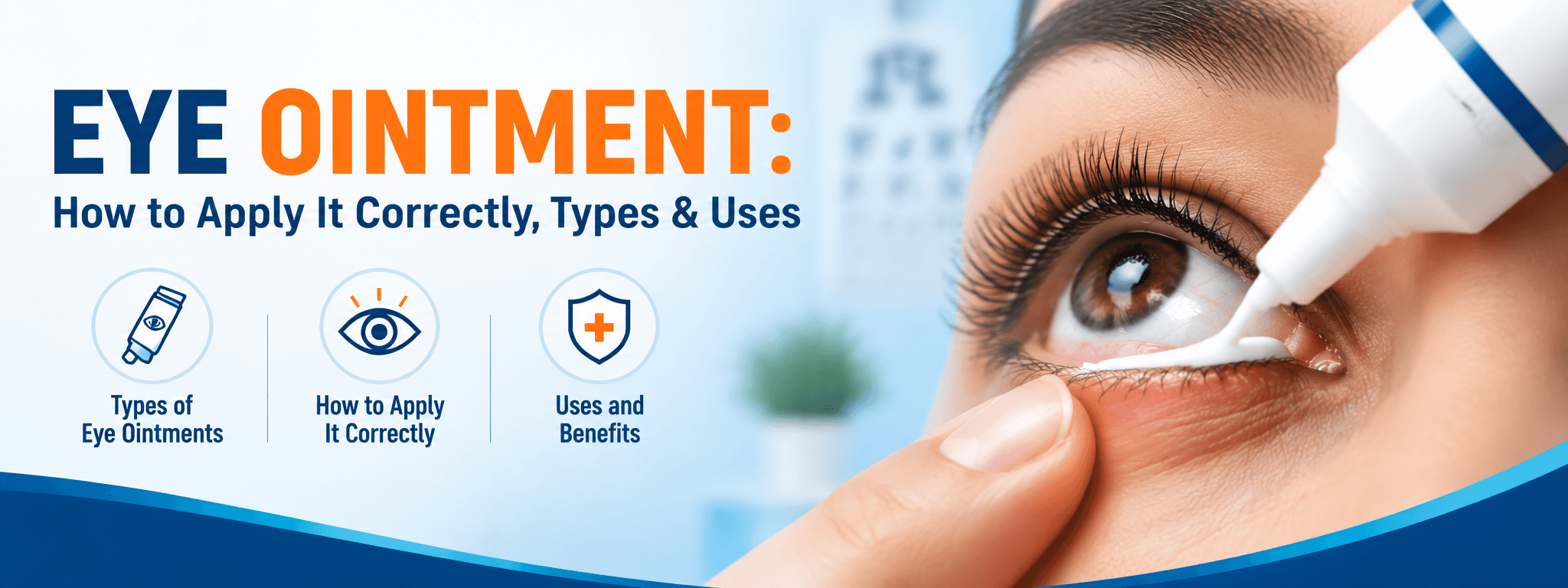
An eye ointment, also called an ophthalmic ointment, is medicine suspended in a soft paraffin base. You place a small strip inside the lower eyelid. Your body heat softens it, and blinking spreads it as a thin film across the eye.
Because it clings to the eye surface, an ointment stays in contact with the tissue much longer than a drop, which drains away within minutes. That is the main reason doctors prescribe it: longer contact, fewer applications, and steady overnight coverage.
The trade-off is vision. An ointment blurs sight for several minutes after each application, which is why it is so often prescribed for bedtime while drops handle the daytime.
Ointment, gel, or drops what is the difference?
|
Eye drops |
Eye gel |
Eye ointment |
|
|
Texture |
Thin liquid |
Thicker liquid, between the two |
Semi-solid, greasy |
|
Container |
Dropper bottle |
Bottle or tube |
Tube or single-use capsule |
|
Time on the eye |
Shortest |
Medium |
Longest |
|
Blurs vision |
Barely |
Briefly |
Yes, for several minutes |
|
Typical timing |
Through the day |
Day or night |
Usually bedtime |
|
Best suited to |
Frequent dosing, daytime use |
Moderate dryness, daytime comfort |
**/yness, young children |
A common prescription pairs the two: drops during waking hours, ointment last thing at night.
Tubes and single-use capsules
In India, eye ointment comes in two formats. The familiar one is a small aluminium tube, usually 3 to 5 grams. The second is a soft gelatin capsule holding enough ointment for one application, often called an eye capsule or eye tube capsule.
To use a capsule, wipe the tip, snip the end with something clean, squeeze the contents into the lower lid, and discard it. Because each capsule is used once and thrown away, there is no part-used tube sitting in a drawer collecting bacteria.
Types of eye ointment and what they treat
Eye ointments fall into a few broad groups. Which one you have matters far more than the brand name printed on the box.
Antibiotic eye ointments
These treat bacterial infections of the eye surface and eyelids bacterial conjunctivitis, blepharitis, and some corneal infections. Common active ingredients in India include chloramphenicol, azithromycin, moxifloxacin, ciprofloxacin, tobramycin, erythromycin, gentamicin and polymyxin B.
Antibiotics work only against bacteria. They do nothing for viral or allergic eye problems, and using them for the wrong condition delays proper treatment.
Antibiotic and steroid combinations
Some ointments combine an antibiotic with a corticosteroid to bring down inflammation alongside the infection. Used correctly, under supervision, they have a genuine role after certain eye surgery, or in specific inflammatory conditions.
Used casually, they cause harm. A steroid on the eye surface can raise the pressure inside the eye, and sustained raised pressure damages the optic nerve. Indian studies of children with allergic eye disease have documented steroid-induced glaucoma and permanent visual loss in children whose families kept buying topical steroids over the counter without follow-up.
Steroids also suppress the eye’s defences. Product labelling for ophthalmic dexamethasone lists contraindications including herpes simplex infection of the corneal surface, most other viral diseases of the cornea and conjunctiva, and fungal disease of the eye. In a hot, humid climate where fungal eye infection is a significant cause of blindness, that is not a theoretical concern.
The practical point is simple, and it appears again below: you need to know whether your ointment contains a steroid.
Lubricating eye ointments for dry eye
These contain no antibiotic. They are pure lubricants, usually a paraffin base, sometimes with hydroxypropyl methylcellulose used to hold moisture on the eye overnight in moderate to severe dry eye.
They are also used to protect the eye when the lids do not close fully during sleep, and after some eye surgery.
Other specialist ointments
Antiviral ointments treat specific viral infections of the eye surface. Dilating ointments are used in particular clinical situations. Both are prescribed and monitored by an eye specialist; they are not medicines to source on your own.
How to apply eye ointment correctly
The technique matters. A strip smeared onto the lashes has not been given.
- Wash and dry your hands thoroughly.
- Take out contact lenses before you start.
- Warm the tube briefly in your hand. Cold ointment comes out in a stubborn lump.
- Sit or stand in front of a mirror, tilt your head back slightly and look up at the ceiling.
- Pull the lower eyelid gently down with one finger to form a small pocket.
- Hold the tube close to the eye, about a centimetre away without letting the tip touch your eye, lashes, fingers or any surface.
- Squeeze out a short strip, roughly the size of a grain of rice, into the pocket. Around one centimetre is the usual amount unless your doctor has said otherwise.
- Twist the tube slightly to break the strip off cleanly, then release the eyelid.
- Close the eye gently for about a minute and blink a few times to spread the film. Do not squeeze the lid shut.
- Wipe away excess with a clean tissue, wipe the tube tip with a separate clean tissue, replace the cap, and wash your hands again.
Expect blurring for a few minutes. Do not drive or ride until your vision is clear.
Applying ointment to the upper eyelid
Occasionally you will be asked to treat the upper lid for a stye pointing upward, or for eyelid margin inflammation along the top lashes.
Look down rather than up. Lift the upper lid gently away from the eye by the lash line, and lay a short strip along the inside edge of the lid margin. Then close the eye and blink to distribute it. If you have been told to treat the lid margin itself rather than the eye, a clean cotton bud can be used on the outer lash line but never inside the eye.
Applying eye ointment to a baby or young child
Two adults make this far easier than one. Lay the child down. One person steadies the head, the other applies.
For babies and small children, place the ointment at the inner corner of the eye, near the nose, rather than trying to aim for the lid pocket. Even if the eye is squeezed shut, the ointment melts and works its way in once the child blinks. Wrapping a small baby in a blanket to keep arms still is standard practice, not cruelty.
If you think it did not go in, you can try once more, but do not keep repeating attempts.
Using drops and ointment together
If you have been prescribed both, drops go in first, ointment last. Wait about five minutes between them. Ointment forms a barrier on the eye surface, so anything applied after it will not get through properly.
If you use more than one type of drop, leave five minutes between those too. Our guide to putting in eye drops covers that technique in detail.
Check the tube before you use it
This takes ten seconds and is the most useful habit in this article.
Find the composition line on the carton or tube; it lists the active ingredients. Then ask two questions:
Does it say “ophthalmic” or “eye”? If a tube does not clearly state it is for use in the eye, it does not go in the eye. Skin antibiotic ointments look similar, sit next to eye products in many homes, and are not sterile or formulated for the eye surface.
Does it contain a steroid? Look for any of these names in the ingredient list: dexamethasone, betamethasone, prednisolone, hydrocortisone, loteprednol, fluorometholone. If one appears, your ointment contains a corticosteroid. That is not automatically wrong, but it means the treatment needs a doctor’s supervision, a defined stopping point, and usually a pressure check if used for more than a short course.
This matters because brand families in India are easy to confuse. The same brand name may exist as an antibiotic-only ointment and as a version with a letter or two added that also contains dexamethasone. The tubes look nearly identical. Reading the composition line, not the brand name, is the only reliable way to tell them apart.
What is normal after applying eye ointment, and what is not
Normal, and usually brief:
- Blurred or hazy vision for a few minutes
- Mild stinging as it goes in
- A greasy feeling on the lashes and lids
- Slight redness immediately afterwards
Sticky lashes are expected. Clean them gently with a warm, damp cloth.
Not normal stop and get medical advice:
- Increasing eye pain rather than settling discomfort
- Vision that stays blurred well after application
- Growing redness, swelling or watering over days rather than improving
- A rash, itching or swelling of the eyelids, which may indicate an allergy to the medicine
- Any swelling of the lips, tongue or throat, or difficulty breathing; this needs emergency care
Five mistakes that turn a simple treatment into a problem
- Applying it with a finger or cotton bud. Fingers carry bacteria into an eye that is already inflamed, and a fingernail can scratch the cornea. Use the tube.
- Putting a skin ointment in the eye. Skin antibiotic ointments carry warnings against ocular use for good reason; some are toxic to the cornea. Where a brand makes both a skin version and an eye version, keep separate tubes and never swap them.
- Letting the tip touch the eye. One contact contaminates the whole tube. If it happens, wipe the tip with a clean tissue and tell your pharmacist.
- Using an old tube for a new problem. A leftover ointment from three months ago is neither sterile nor necessarily the right medicine. Reaching for it also delays diagnosis of what is actually wrong this time.
- Continuing past the prescribed course. Prolonged antibiotic use encourages resistance and secondary infection. Prolonged steroid use is worse. If symptoms have not settled by the end of the course, that is a reason to return to the doctor, not to keep going.
One further caution: ointments can slow the healing of a corneal surface wound. If you have a scratched or injured eye, the choice of treatment belongs to an ophthalmologist, not to whatever is in the cupboard. A painful red eye in a contact lens wearer in particular needs same-day examination for a possible corneal ulcer.
How to store eye ointment
- Keep it in a cool, dry place away from direct sunlight, unless the pack says refrigerate. Most eye ointments do not need the fridge; that is usually a rule for drops.
- Discard the tube about a month after opening, even if ointment remains. Sterility does not last once the seal is broken.
- Keep the cap on tightly and never touch the tip.
- One tube, one person. Never share eye medicine, even within a family.
- Return unused ointment to a pharmacy rather than keeping it “just in case.”
When to see an eye doctor
Book an examination promptly if you have:
- Eye pain, as opposed to irritation or grittiness
- Reduced vision that does not clear within minutes of applying ointment
- No improvement after two days, or symptoms getting worse
- Strong sensitivity to light
- A white or cloudy patch on the coloured part of the eye
- Symptoms after an eye injury, in a contact lens wearer, or after recent eye surgery
- A newborn or young infant with a red, sticky or swollen eye
- Recurrent styes or eyelid inflammation that keeps returning; this often points to an underlying eyelid or tear film problem worth treating properly
If you have been using a steroid-containing ointment for more than a short course, ask specifically about an eye pressure check. Raised pressure causes no symptoms until damage is already done.
Conclusion
Eye ointment is a straightforward medicine that people struggle with mainly because nobody shows them the technique. Warm the tube, aim for the pocket inside the lower lid, use a rice-grain strip, never use a finger, and accept a few minutes of blur.
The one habit worth adding is reading the composition line before the first application. Knowing whether you are holding a plain antibiotic, a lubricant, or something containing a steroid changes how carefully the treatment needs to be supervised, and it takes ten seconds.
If your eye is painful, your vision is dropping, or things are not improving within a couple of days, stop guessing and have it examined.